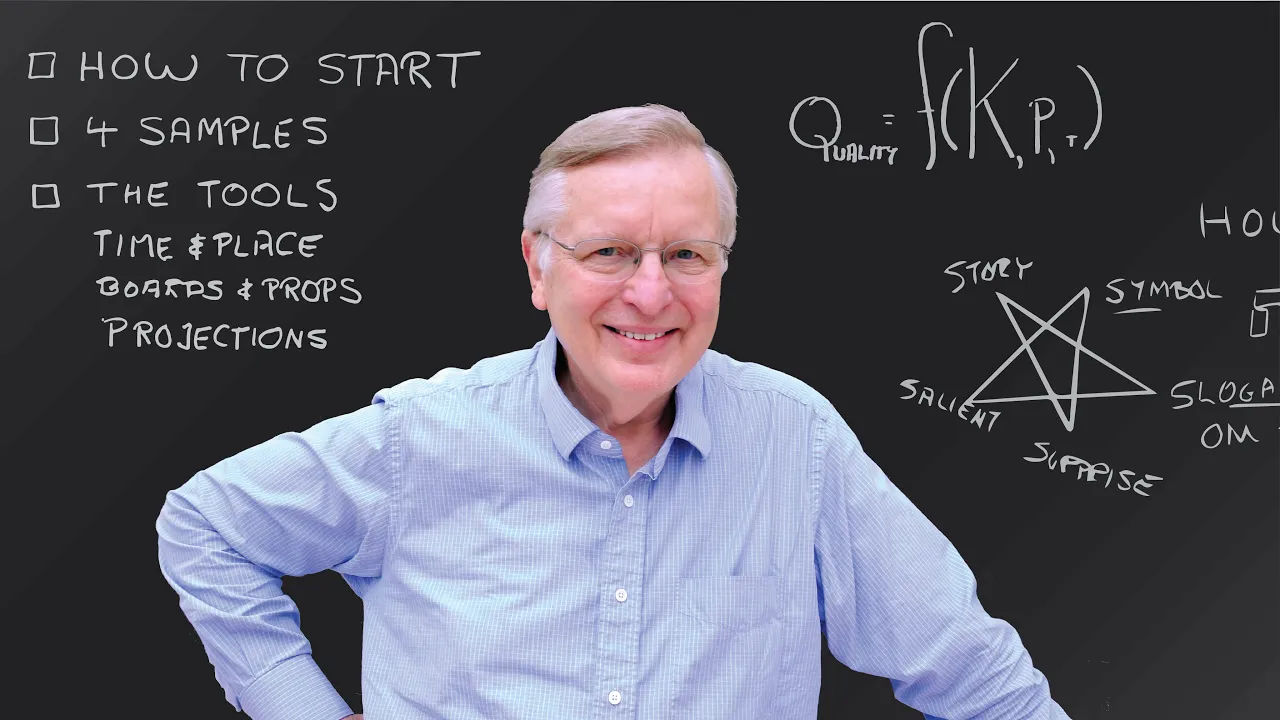
Patrick Winston 是美國計算機科學家,也是麻省理工學院的教授。《如何表達》(How to Speak)於 MIT開設的課程。據分享已經開超過40年。 與本演講之相關著作《麻省理工全能表達課 / Make it Clear: Speak and Write to Persuade and Inform》
原始影片
How to Speak
有字幕
麻省理工学院MIT公开课《如何说话 How to Speak》by Patrick Winston
Youtube 字幕
PATRICK WINSTON: The Uniform Code of Military Justicespecifies court martial for any officer who sends a soldier into battle without a weapon.
There ought to be a similar protection for students because students shouldn't go out into life without the ability to communicate,and that's because your success in life will be determined largely by your ability to speak,your ability to write, and the quality of your ideas,in that order.
I know that I can be successful in this because the quality of communication, your speaking, your writing, is largely determined by this formula.
It's a matter of how much knowledge you have, how much you practice with that knowledge, and your inherent talent, and notice that the T is very small.
What really matters is what you know.
This point came to me suddenly a few decades ago when I was skiing at Sun Valley.
I had heard that it was Celebrity Weekend, and one of the celebrities was Mary Lou Retton, famous Olympic gymnast, perfect 10s in the vault.
And I heard that she was a novice at skiing, so when the opportune moment arrived, I looked over on the novice slope and saw this young woman who, when she became unbalanced, went like that.
And I said that's got to be her.
That must be the gymnast.
But then, it occurred to me, I'm a much better skier than she is, and she's an Olympic athlete-- not only an ordinary Olympic athlete, an outstanding one.
And I was a better skier because I had the K, and I had the P, and all she had was the T.
So you can get a lot better than people who may have inherent talents if you have the right amount of knowledge.
So that's what my objective is today, and here's my promise.
Today, you will see some examples of what you can put in your armamentarium of speaking techniques, and it will be the case that some one of those examples, some heuristic, some technique, maybe only one, will make-- will be the one that gets you the job.
And so this is a very non-linear process.
You never know when it's going to happen, but that is my promise.
By the end of the next 60 minutes, you'll have been exposed to a lot of ideas, some of which you'll incorporate into your own repertoire, and they will ensure that you get the maximum opportunity to have your ideas valued and accepted by the people you speak with.
Now, in order to do that, we have to have a rule of engagement, and that is no laptops, no cell phones.
So if you could close those, I'll start up as soon as you're done.
Some people ask why that is a rule of engagement, and the answer is, we humans only have one language processor.
And if your language processor is enga--could you shut the laptop, please?If your language processor is engaged browsing the webor reading your email, you're distracted.
And worse yet, you distract all of the people around you.
Studies have shown that.
And worse yet, if I see a open laptop somewhere backthere or up here, it drives me nuts, and I do a worse job.
And so that ensures that all of your friendswho are paying attention don't get the performancethat they came to have.
So that's it for preamble.
Let's get started.
First thing we talk about, of course, is how to start.
Some people think the right thing to dois to start a talk with a joke.
I don't recommend it, and the reasonis that, in the beginning of a talk,people are still putting their laptops away.
They're becoming adjusted to your speaking parameters,to your vocal parameters, and they're not ready for a joke.
So it doesn't work very well.
They usually fall flat.
What you want to do instead is start with empowerment promise.
You want to tell people what they'regoing to know at the end of the hourthat they didn't know at the beginning of the hour.
It's an empowerment promise.
It's the reason for being here.
What would be an example?Oh, I see.
At the end of this 60 minutes, you will know thingsabout speaking you don't know now,and something among those things you knowwill make a difference in your life.
Yeah, that's an empowerment promise,so that's the best way to start.
So now that I've talked a little bit about how to start,what I want to do is give you some samples of heuristicsthat are always on my mind when I give a talk,and first of these heuristics is that it's a good idea to cycleon the subject.
Go around it.
Go round it again.
Go round it again.
Some people say, tell him what you want to tell him.
Tell him again, and then tell him a third time,as if people weren't intelligent.
But the point is--the reason is-- well, there are many reasons, one of whichis, at any given moment, about 20% of youwill be fogged out no matter what the lecture is.
So if you want to ensure that the probability that everybodygets it is high, you need to say it three times.
So cycling is one of the things that I alwaysthink about when I give a talk.
Another thing I think about is, in explaining my idea,I want to build a fence around it so that it's not confusedwith somebody else's idea.
So if you were from Mars, and I was teaching youabout what an arch is, I might say to you,well, that's an arch.
And that's not to be confused with some other thingsthat other people might think is--this is not an arch.
That's not an arch.
I'm building a fence around my ideaso that it can be distinguished from somebody else's idea.
So in a more technical sense, I might say, well,my algorithm might similar--might seem similar to Jones's algorithm,except his is exponential, and mine's linear.
That's putting a fence around your ideaso that people can not be confused about how itmight relate to something else.
The third thing on this list of samplesis the idea of verbal punctuation.
And the idea here is that, because peoplewill occasionally fog out and need to get back on the bus,you need to provide some landmark places whereyou're announcing that it's a good time to get back on.
So I might, in this talk, say somethingabout this being my outline.
The first thing we're going to do is talk about how to start.
Then we're going to deal with these four samples,and among these four samples, I'vetalked about the first idea-- that's cycling.
The second idea, building-- and now,the third idea is verbal punctuation.
So I'm enumerating and providing numbers.
I'm giving you a sense that there's a seam in the talk,and you can get back on.
So now, we're on a roll, and since we're on a roll,can you guess what fourth idea might be here--an idea that helps people get back on the bus?AUDIENCE: Ask a question.
PATRICK WINSTON: Yes?AUDIENCE: Ask a question.
[INAUDIBLE]PATRICK WINSTON: Ask a question, yes.
Thank you.
So ask a question.
And so I will ask a question-- how much dead air can there be?How long can I pause?I counted seven seconds.
It seemed like an eternity to me to wait and not say anythingfor seven seconds, but that's the standard amount of timeyou can wait for an answer.
And of course, the question has to be carefully chosen.
It can't be too obvious because then peoplewill be embarrassed to say it, but the answers can'tbe too hard because then nobody will have anything to say.
So here are some sample heuristicsyou can put in your armamentariumand build up your repertoire of ideas about presentation.
And now, if this persuades you that thereis something to know, that there is knowledge,then I've already succeeded because what I want to convinceyou of, is if you watch the speakers you admire and feelare effective, and ask yourselveswhy they're successful, then you canbuild up your own personal repertoireand develop your own personal style.
And that's my fundamental objective,and the rest of this talk is about someof the things that are in my armamentariumthat I think are effective.
So next thing on our agenda, as westart to discuss these other things,is a discussion of time and place.
So what do you think is a good time to have a lecture?11 AM?Yeah.
And the reason is most people at MIT are awake by then,and hardly anyone has gone back to sleep.
It's not right after a meal.
People aren't fatigued from this or that.
It's a great time to have a lecture.
So that brings me, next, to the question of whatabout the place?And the most important thing about the placeis that it be well lit.
This room is well lit.
Problem with other kinds of rooms is that we humans,whenever the lights go down, or wheneverthe room is dimly lighted, it signalsthat we should go to sleep.
So whenever I go somewhere to give a talk,even today, the first thing I do whenI speak to the audio-visual peopleis say, keep the lights full up.
Oh, they might reply, people will see the slides betterif we turn the lights off, and then I reply,it's extremely hard to see slides through closed eyelids.
What else can you say about the place?Well, the place should be cased, and Imean that in a colloquial sense, of like if you'rerobbing a bank, you would go to the banksome occasions before to see what it's like,so there are no surprises when you do your robbery.
So whenever I go somewhere to speak,the first thing I ask my host to do is to take me to the placewhere I'll be speaking so that if there are any weirdnesses,I'll be able to deal with it.
Sometimes, it might require some intervention.
Sometimes, it just might require me to understandwhat the challenges are.
So when I came here this morning,I did what I typically do.
I imagined that all the seats werefilled with disinterested farm animals,and that way, I knew that, no matter how bad it was,it wouldn't be as bad as that.
So finally, it should be reasonably--it should be reasonably populated.
It should be the case that--if there were 10 people in this hall,everyone would be wondering, what'sgoing on that's so much more interesting that nobody's here.
So you want to get a right sized place that's--doesn't have to be packed, but ithas to be more than half full.
So those are some thoughts about a time and place.
Next thing I want to talk about is a subjectof boards and props and slides.
Well, these are the tools of the trade.
I believe that this is the right tool for speakingwhen your purpose is informing.
The slides are good when your purpose is exposing,but this is what I use when I'm informing, teaching, lecturing,and there's several reasons why I use it.
For one thing, when you use the board,you have a graphic quality.
It's the case that, when you have a board, thenyou can easily exploit the fact that you can use graphicsin your presentation.
So that's the graphic quality that I like, and the next thingI like is the speed property.
The speed with which you write on the blackboardis approximately the speed at which people can absorb ideas.
If you go flipping through a bunch of slides,nobody can go that fast.
Finally, one great property of a boardis that it can be a target.
Many people who are novices at speakingfind themselves suddenly aware of their hands.
It's as if their hands were private parts that shouldn'tbe exposed in public, so right away, they go into the pockets,and this is considered insulting in some parts of the world.
Or alternatively, maybe the handswill go in back like this.
I was once in a convent in Serbia, and my host--as soon as we entered, a nun came up to usand offered us a refreshment.
And I was about to say, no, thank you,and he said, eat that stuff or die.
It's a question of local custom and politeness.
But then before anything happened there,the nun pulled my hands out like thisbecause it was extraordinarily insulting in that cultureto have your hands behind your back.
So why is that?Well, it's usually supposed that that'sthat it has to do with whether you're concealing a weapon.
So if your hands are in your pockets or behind your back,then it looks like you might have a weapon,and that's what I mean by the virtue--one of these virtues of the board.
Now, you have something to do with your hands.
You can point out the stuff.
I was once watching Seymour Papert give a lecture,and I thought it was terrific.
So I went a second time--first time to absorb the content, second timeto note style.
And what I discovered is that Papert was constantlypointing at the board.
And then I thought about it a little while,and I noted that none of the stuff he was pointing tohad anything to do with what he was saying.
Nevertheless, it was an effective technique.
So that's just a little bit about the virtueof blackboards.
Now, I want to talk about props.
The custodians of knowledge about propsare the playwrights.
Many decades ago, I saw a play by Henrik Ibsen.
It was Hedda Gabler.
I remember vaguely that it was about a woman in an unhappymarriage, and her husband was in competition for an academic jobwith somebody else.
And he was going to lose partly because he was boring,and partly because the competitor had justwritten a magnificent book.
By the way, this is back in the daysbefore there were copying machines and computers.
Anyhow, as the play opens, there's a potbellied stove,and in the beginning of the play,the potbelly stove, with its open door,just has some slightly glowing embers.
But the potbellied stove is always there,and as tension mounts in the play,and you see this manuscript, thisprop that Ibsen so artfully used, you just knowthat something's going to happen,because as the play goes on, the fire gets bigger and hotterand finally all consuming, and you justknow that that manuscript is going to go into that fire.
This memorable thing is what I remember about the play.
So playwrights have got this all figured out,but on the other hand, they're not the only peoplewho can use props.
Here's an example of the use of a prop, alsodue to Seymour Papert.
He was talking about how it's important to lookat the problem in the right way, and here'san example that not only teaches that, but makes it possiblefor you to embarrass your friendsin mechanical engineering.
So here's what you do.
Take a bicycle wheel, and you start it spinning.
And then you put some torque on the axle,or equivalently, you blow on the edge.
And the issue is, does it go that way,or does it go that way?Now, the mechanical engineers will immediately say, oh, yes,I see-- right hand screw wheel.
And they'll put their fingers in this position,but forget exactly how to align their fingerswith the various aspects of the problem.
And so it's usually the case that they get it rightwith about a 50% probability.
So their very fancy education gets them upto the point where they're equivalent to flipping a coin.
But it doesn't have to be that waybecause you can think about the problem a little differently.
So here's what you do.
You take some duct tape, and you put itaround the part of the wheel like that.
And now, you start to think about, not the whole wheel,but just a little piece that's underneath the duct tape.
So here, that piece comes rolling over the top,and at this point, you blow on it with a puff of air.
Forgetting about the rest of the wheel,what happens to that little piece that'sunder the duct tape?It must want to go that way because youbanged on it like that.
It's already going down like that.
And what about the next piece?Same thing.
Next piece?Same thing.
So the only thing that can happenis that the wheel goes over like that.
And so now, you'll never wonder againbecause you're thinking about the problem in the right way,and it's demonstrated by the use of a prop.
You can try this after we're done.
Another example I like to rememberis one from when I was taking 8.
01.
Alan Lazarus was the instructor at the time,and he was talking about the conservation of energy, kineticand potential.
And there was a long wire in a ceiling in 26-100 attachedto a much bigger steel ball, but one--not one like this.
And Lazarus took the ball up against the wall like this.
He put his head flat against the wall to steady himself,and then he let go, and the pendulumtakes many seconds to go over and back,and then gently kisses Lazarus's nose.
And so you have many seconds to think,this guy really believes in the conservation of energy.
Do not try this at home.
The problem is that, the first time you do this,you may not just let go.
There's a natural human tendency to push.
So that's a little bit on a subject of props.
It's interesting.
Whenever surveys are taken, students always say more chalk,less PowerPoint.
And why would that be?Props are also very effective.
Why would that be?I'll give you my lunatic fringe view on this.
It has to do with what I would call empathetic mirroring.
When you're sitting up there watching me write on the board,all those little mirror neurons in your head, I believe,become actuated, and you can feel yourselfwriting on the blackboard.
And even more so, when I talk about this steel ball goingthat way and this way, you can feel the ballas if you were me, and you can't do that with a slide.
You can't do it with a picture.
You need to see it in the physical world.
That's why I think that--oh, yes, of course, it's--there are speed questions involved, too,that have to be separated out.
But I think the empathetic mirroringis why props and the use of a blackboard are so effective.
Well, let's see-- oh, yes, there is one more thingby way of the tools, and that hasto do with the use of slides.
I repeat, I think they're for exposing ideas,not for teaching ideas, but that's what we do in a job talkor conference talk--expose ideas.
We don't teach them.
So let me tell you a little bit about my views on that.
I remember, once, I was in Terminal A at Logan Airport.
I'd just come back from a really miserable conference,and the flight was really horrible.
It was one of those that feels like an unbalanced washingmachine.
And for the only time in my life,I decided to stop on my way to my car and have a cup of coffeeand relax a little bit.
And as I was there for a few minutes, someone came up to meand said, are you Professor Winston?I think so, I said.
I don't know.
I guess I was trying to be funny.
In any event, he said, I'm on my way to Europeto give a job talk.
Would you mine critiquing my slides?Not at all, I said.
You have too many, and they have too many words.
How did you know, he said, thinking perhaps Ihad seen a talk of his before.
I hadn't.
My reply was, because it's always true.
There are always too many slides, always too many words.
So let me show you some extreme examples of how not to useslides.
Well, for this demonstration, I need to be way over hereand when I get over here, then I can start to say things like,one of the things you shouldn't do is read your transparencies.
People in your audience know how to read,and reading will just annoy them.
Also, you should be sure that youhave only a few words on each transparency,and that the words are easy to read.
And I hope I'm driving you crazy because I'mcommitting all kinds of crimes, the first of whichis that there are too many words on the slide.
Second of which is, I'm way over there,and the slide's way over there.
So you get into this tennis match feelingof shifting back and forth between the slideand the speaker.
You want the slides to be condiments to whatyou're saying, not the main event or the opposite wayaround.
So how can we fix this?Step number one is to get rid of the background junk.
That's always distraction.
Step number two is to get rid of the words.
When I reduced the words to these,then everything I read a previous time,I'm not licensed to say, because it's not on the slide.
I'm not reading my slides anymore,but I'm saying what was written on the slidesin a previous example.
So what else can we do to simplify this?Well, we can get rid of the logos.
We don't need them.
Simplification.
What else can we do?Get rid of the title.
Now, I want to talk to you about some rules for slidepreparation.
I'm telling you the title.
It doesn't have to be up there.
By reducing the number of words on the slide,I'm allowing you to pay more attention to meand less to what's written on the slide.
I mentioned it before-- we-- have only one languageprocessor, and we can either use it to read stuffor to listen to the speaker.
And so if we have too many words on the slide,it forces people in the audience to read this stuffand not listen.
A student of mine did an experiment a few years ago.
He taught some students some web-based programming ideas.
Half the information was on slides, he said the other half,and then for a control group, he reversed it.
And the question was, what did the subjects--that is to say, freshmen at his fraternity--what did the subjects remember best, what he said,or what they read on the slide?And the answer is, what they read on the slide.
When their slides have a lot of material on it,they don't pay attention to the speaker.
In fact, in the after action report, one of the subjectssaid, I wish you hadn't talked so much.
It was distracting.
Well, the last item is eliminate clutter.
Here's some clutter.
No reason even for those bullets.
So the too many words problem is a consequenceof a crime Microsoft has committedby allowing you to use fonts that are too small.
So you should all have a sample slide like thisthat you can use to determine what the minimum fontsize is that's easily legible.
[INAUDIBLE],, what do you think of those?AUDIENCE: Which size is right?PATRICK WINSTON: What's that?AUDIENCE: Did you ask me what size is right?PATRICK WINSTON: Yeah, minimum, maybe.
AUDIENCE: 40 or 50.
PATRICK WINSTON: Yeah, he says 40 or 50.
I think that's about right.
35 is beginning to get too small, not necessarilybecause you can't read it, but because you're probablyusing it to get too many words on the slide.
What other crimes do we have?Well, we have the laser pointer crime.
And for that-- in the old days, whenwe didn't have laser pointers, we used wooden ones,and people would go waving these things around.
And pretty soon it became almost like a baton twirling contest,so here's what I recommended in the old daysfor dealing with this kind of pointer.
This is an example of use of a prop.
Jim Glass up there saw this talk about 20 years ago,and said, oh, yeah, I remember that talk.
That's the one where you broke the pointer.
It's amazing how props tend to bethe things that are remembered.
Well, now, we don't have physical pointers anymore.
We've got laser pointers.
It's a wonder more people aren't driven into epileptic fitsover this sort of stuff.
Well, here's what tends to happen.
Look at that.
It's a lovely recursive picture, and I can become part of itby putting that laser beam right on the back of my headup there.
Then what do you see?You see the back of my head.
I have no eye contact, no engagement, nothing.
I was sitting with a student watching a talk one day,and she said, you know what, we could all leave,and he wouldn't know.
So what happens when you use a laser pointer?You can't use a laser pointer without turning your headand pointing it at something, and when you do that,you lose contact with the audience.
You don't want to do it.
So what do you do if you need to identify somethingin your image, and you don't wantto point at it with a laser?This is what you do.
Put a little arrow on there and say,now, look at that guy at the end of arrow number one.
You don't need to have laser pointer to do that.
The too-heavy crime-- when peopleask me to review a presentation, Iask them to print it out and lay it out on a table.
When they do that, it's easy to see whether the talk istoo heavy, too much text, not enough air, notenough white space, not enough imagery.
This is a good example of such a talk--way too heavy.
The presenter has taken advantage of a small font sizesto get as much on the slide as he wanted.
Lots of other crimes here, but the too-heavy-- the factthat it's too heavy is what I wanted to illustrate.
So here, by contrast, another talk--one I gave a few years ago.
It's not-- it wasn't a deeply technical talk,but I show it to you because there's air in it.
It's mostly pictures of things.
There are three or four slides that have text on them,but when I come to those, I give the audience time to read them.
And they're there because they might havesome historical significance.
The first slide with a lot of text on itis an extraction from the 1957--from the proposal for the 1957 AI conference at Dartmouth.
Extraordinarily interesting event,and that historical extraction from the proposalhelps drive that point home.
What else have we got here?Oh, yeah, your vocabulary word for the day.
This is an hapax legomenon.
What that means is, this is the kind of slideyou can get away with exactly once in your presentation.
This is a slide that got some currency some yearsago because it shows the complexity of governingin Afghanistan by showing how impossibly complex it is.
It's something you in the audience can't understand,and that's the point, but you can't have many of these.
You can have one per work, one per presentation,one per paper, one per book.
That's what hapax legomenon is, and this is an example of it.
Well, I've shown you some crimes.
So you might be asking, do these crimes actually occur?So they do.
[LAUGHTER]There's the hands in the pockets crime.
There's a crime and time and place selection here.
This is how you get to the Bartos Theater.
First thing you do is you get on these stepsover at the Media Lab, then you cross this large open space,then you turn right down this corridor.
[LAUGHTER]At this point, whenever I go in there,I wonder if there are torture implements around the corner.
[LAUGHTER]And then when you get in there, youget into this dark, gloomy place.
So it's well named when they call it the Bartos Theaterbecause it's a place where you can watch a movie,but it's not a place where you can give a talk.
Now, on a subject of does it happen,here's a talk I attended a while back in Stata.
Notice that the speaker is far away from the slides.
Speaker's using a laser pointer.
And you say to me, well, what's happening here?It's, by the way, the 80th - 80th!slide of the presentation.
Notice that it extends with the words,this is the first of 10 conclusions slides.
[LAUGHTER]So what's the audience reaction?That's the sponsor of the meeting.
[LAUGHTER]He's reading his email.
This is the co-sponsor of the meeting.
He's examining the lunch menu.
[LAUGHTER]What about this person?This person looks like he's paying attention,but just because it's a still picture.
If you were to see a video, what you would seeis something like this [YAWNS].
[LAUGHTER]So yeah, it does happen.
Well, now, that's a quick review of tools.
Now, I want to talk about some special cases.
We could talk a little bit about the informingor to say another way, doing what I'm doing now.
But I'll just say a few words about that.
In that kind of presentation, youwant to start with a promise like I did for this hourthat we're going through now.
And then it comes to the questionof how do you inspire people?I've given this talk for a long time,and a few years ago, our department chairmansaid, would you please give this talk to a new faculty,and be sure to emphasize what it takes to inspire students.
And strangely, I hadn't thought about that question before.
So I started a survey.
I'd talked to some of my incoming freshmen advisees,and I talked to senior faculty and everythingin between about how they've been inspired.
What I found from the incoming freshmenis that they were inspired by some high school teacher whotold them they could do it.
What I found in the senior faculty,they were inspired by someone whohelped them see a problem in a new way.
And what I saw from everyone is that they were inspired whensomeone exhibited passion about what they were doing,exhibited passion about what they were doing.
So that's one way to be inspiring.
It's easy for me because I do artificial intelligence.
And how can you not be interestedin artificial intelligence?[LAUGHTER]I mean, if you're not interested in artificial intelligence,you're probably not interested in interesting things.
So when I'm lecturing in my AI class, it's natural for meto talk about what I think is cooland how exciting some new idea is.
So that's the kind of expression of passionthat makes a difference while informing with respectto this question of inspiring.
Oh, yeah and of course, during this promise phase,you can also express how cool stuff is.
Let me give you an example of a lecture that starts this way.
I'm talking about resource allocation.
It's the same sort of stuff you would think of when your--it's the same sort of ideas you wouldneed if you're allocating aircraft to a flight scheduleor trying to schedule a factory or something like that.
But the example is putting colorson the states in the United Stateswithout any bordering states having the same color.
So here it goes.
This is what I show at the beginning of the class.
This is a way of doing that coloring.
And you might say, well, why don't we wait till it finishes?Would you like to do that?No?Well, we're not going to wait till it finishesbecause the sun will have exploded and consumed the earthbefore this program finishes.
[LAUGHTER]But with a slight adjustment to how the program works, whichI tell my students you will understand in the next 50minutes, this is what you get.
Isn't that cool?You got to be amazed by stuff thattakes a computation from longer than the lifetimeof the solar system into a few seconds.
So that's what I mean by providing a promise upfrontand expressing some passion about whatyou're talking about.
Well, the last item in this little blockhere is it has to do with what peoplethink that they do it at MIT.
You ask faculty what the most important purpose is,and they'll say, well, the most important thing I dois teach people how to think.
And then you say oh, that's great.
How do you teach people how to think?Blank stare.
No one can quite respond to that part,that natural next question.
So how do you teach people how to think?Well, I believe that we are storytelling animals.
And that we start developing our story,understanding and manipulating skillswith fairy tales in childhood and continue onthrough professional schools like law, business, medicine,everything.
And we continue doing that throughout life.
So if that is what thinking is all about.
And we want to teach people how to think,you provide them with the stories they need to know,the questions they need to ask about those stories,mechanisms for analyzing those stories,ways of putting stories together,ways of evaluating how reliable a story is.
And that's what I think you need to do when you teach peoplehow to think.
But that's all about education.
And many of you here are not necessarilyfor that, but rather for this part,for persuading, which breaks down into several categories,oral exams, not shown, shop talks, getting famous.
I won't say much about oral exams other than the factthat they used to be a lot scarier than they are today.
In the old days, reading the literaturein a foreign language was a part of that.
And there was a high failure rate.
And when you look back on those failures,the most usual reason for people failing an oral examis failure to situate and a failure to practice.
By situate, I mean, it's important to talkabout your research in context.
This is a problem that's being pursued all over the world.
There hasn't been any progress before me in the past 30 years.
Everyone is looking for a solutionbecause it will have impact on somany other things, such situating and time and placeand feel.
And then as far as practice is concerned, yes,practice is important.
But that doesn't mean showing your slides to the peopleyou share an with.
The problem with that is that if people know what you're doing,they will hallucinate that there'smaterial in your presentation that isn't thereif it isn't there.
A variation on the scene, by the way,is your faculty supervisor is not a very good personto help you debug a talk because they, in fact, knowwhat you're doing.
And they will, in fact, hallucinatethere's material in your presentation that isn't there.
So you need to get together with some friends whodon't know what you're doing and have them--well, you start the practice session by saying,if you can't make me cry, I won't value as a friendanymore.
[LAUGHTER]And then when you get to the faculty on a oral exam,it will be easy.
You see, difficulty-- the amount of flakyou'll get from somebody is proportional to age.
The older somebody is, the more theyunderstand where they are in the world.
But the young people are trying to show the old peoplehow smart they are, so it's subtly vicious.
So whenever you have an opportunityto have an examining committee that'sfull of people with gray hair, that's what you want.
Well, that's just a word or two about somethingI haven't listed here.
Let's get into the subject of job talks.
So I was sitting in a bar many years ago in San Diego.
I was a member of the Navy Science Board,and I was sitting with a couple of my colleagues on the boardDelores Etter from the University of Colorado.
She made me so jealous I could spit because she'd written 21books, and I'd only written 17.
And then the other one was Bill Weldonfrom the University of Texas.
He was an electromagnetism guy, and heknew how to use rail guns to drive steel rods through tankarmor.
These were interesting people.
So I said, what do you look for in a faculty candidate?And within one microsecond, Deloressaid, they have to show us they'vegot some kind of vision, quickly followed by Bill who said,they have to show us that they've done something.
Oh, that sounds good, I said.
And then I said to them, how longdoes a candidate have to establish these two things?What do you think?Well, compare your answer to theirs.
Five minutes.
So if you haven't expressed your vision,if you haven't told people that you've done something in fiveminutes, you've already lost.
So you have to be able to do that.
And let me just mention a couple of things in that connection.
Here, the vision is in part, a problemthat somebody cares about and something new in your approach.
So the problem is understanding the natureof human intelligence.
And the approach is asking questionsabout what makes us different from chimpanzeesand Neanderthals.
Is it merely a matter of quantity,or we're just a little bit smarter in some continuous way?Or do we have something that's fundamentally differentthat chimpanzees don't have and Neanderthals either?And the answer is yes, we do have something different.
We are symbolic creatures.
And because we're symbolic creatures,we can build symbolic descriptionsof relations and events.
We can string them together and make stories.
And because we can make stories, that's what makes us different.
So that's my stump speech.
That's how I start most of my talkson my own personal research.
How do you express the notion that you've done something?By listing the steps that need to be taken in order to achievethe solution to that problem.
You don't have to have done all of those steps.
But you can say here's what needs to be done.
An example, here's what needs to be done.
We need to specify some behavior.
We need to enumerate the constraints thatmake it possible to deal with that behavior.
We have to implement a system because we're engineers,and we don't think that we've understood somethingunless we can build it.
And we've built such a system, and we'reabout to demonstrate it to you today.
That would be an example of enumerating a series of stepsneeded to realize the vision.
So then blah, blah, blah, blah, blah, blah, blah, blah.
And then you conclude by--you conclude by enumerating your contributions.
It's kind of mirror of these steps.
And it helps to establish that you've done something.
So that's a kind of general purpose frameworkfor doing a technical talk.
Now, only a few more things left to do today.
Getting famous is the next item on our agendabecause once you've got the job, youneed to think a little bit about howyou're going to be recognized for what you do.
So oh, first of all, why should you care about getting famous?I thought about this in connectionwith a fundraising event I attendedonce, a fundraising event for raising moneyto save Venice from going under water and having all of its artdestroyed.
Anyway, I was sitting here, and JC was sitting here.
That was Julia, the late Julia Child.
And as the evening wore on, more and more peoplewould come up and ask Julia to autograph somethingor express a feeling that she had changed their life.
And it just happened over and over again.
So eventually, I turned to Julia, and I said, Ms.
Child,is it fun to be famous?And she thought about it for a second.
And she said, you get used to it.
[LAUGHTER]But you know what occured to me?You never get used to being ignored.
So it's-- here's a way to think about it.
Your ideas are like your children.
And you don't want them to go into the world in rags.
So what you want to do is to be surethat you have these techniques, these mechanisms,these thoughts about how to present ideas that you have sothat they're recognized for the value that is in them.
So that's why it's a legitimate thing to concern yourselfwith packaging.
Now, how do you get remembered?Well, there's something I like to call Winston's star.
And every one of the items I'm about to articulate startswith an S.
So if you want your presentation ideasto be remembered, one of the things you need to dois to make sure that you have some kind of symbol associatedwith your work.
So this arch example is actually from my PhD thesismany, many years ago.
And in the course of my work at that time,this work on arch learning became mildly famous,and I didn't know why.
It was only many years later that I realizedthat that work accidentally had all of the elementson this star.
So the first element is that there was a kind of symbol.
It's the arch itself.
Next thing you need is some kind of slogan,a kind of phrase that provides a handle on the work.
And in this case, the phrase was one shot learning.
And it was one shot because the program I wrotelearned something definite from every example thatwas presented to us.
So in going from a model based on this configurationto something that isn't an arch base on that configuration,the program learned that it has to be on top,one shot learning.
So that's a symbol, slogan.
And now we need a surprise.
Yeah, the surprise is you don't need a million examplesof something to learn.
You can do it with one example if you'resmart enough to make use of that example appropriately.
So that was the surprise.
You can learn something definite from each example.
Next item was a salient idea.
Now, when I say salient idea, I don't mean important.
What I mean is an idea that sticks out.
Some theses, funnily enough, have too many good ideas,and you don't know what it's all about because which one is it?So you need an idea that sticks out.
And the idea that stuck out here was the notion of a near miss.
You see, this is not an arch, but it doesn't miss by much.
So it's a near miss.
And finally, you need to tell the storyof how you did it, how it works, why it's important.
So that's a bit on how to not so much get famous,but how to ensure that your work is recognized.
Well, we're almost finished because now we'redown to this last item, which is how to stop.
And when we come to that, there'sa question of all right, well, what is the final slide?And what are the final words?So for the final slide, let me give yousome examples of possibilities.
How about this one?Well, you might see that slide and think to yourself,there are 1,000 faculty at MIT.
Nice piece of work, but not so much,but it's only a tiny piece of work if you divide by 1,000.
So when you show a whole gigantic list of collaboratorsat the end of a talk, it's a kind of let downbecause it suggests that nobody knows.
Well, did you do anything significant?Now, you've got to recognize your collaborators, right?So where do you do that?Not on the last slide, on the first slide.
All this was on the first slide.
These are the collaborators, so you don'twant to put them at the end.
You don't want a slide like this.
How about this one?This is the worst possible way to end a talk.
[LAUGHTER]Because this slide can be up there for 20 minutes.
I've seen it happen.
It squanders real estate.
It squanders an opportunity to tell people who you are.
It's just--What about this one?I often see it.
I never see anybody write it down.
Also, it wastes opportunity.
Oh my God, even worse.
All of these lines do nothing for you.
They waste an opportunity for you to tell people--to leave people with what you--with who you are.
Well, what about this?Is this a good one?It might seem so at first, but here's the problem.
If you say these are my conclusions,these are perfectly legitimate conclusionsthat nobody cares about.
What they care about is what you have done.
And that's why your final slide shouldhave this label, contributions.
It's a mirror of what I said over there about how job talksought to be like a sandwich.
And the final slide, the one that'sup there while people are asking questions and filing out,it ought to be the one that has your contributions on it.
Here's an example from my own stump speech.
Yeah, this is what I talk about a lot.
Yes, here are the things that I typically demonstrate.
And I wait for people to read it.
And the final element there is this is what we get out of it,so that's an example of a contribution slide.
All right, now, what about the other part?You got your final slide up there.
It's a contribution slide.
Somehow you have to tell people you're finished.
So let's see it, check out a few possibilities.
One thing you could do in the final wordsis you could tell a joke.
It's OK.
By the time you're done, people have adjusted themselvesto your voice parameters.
They're ready for a joke.
I was sitting in another bar, this time in Austin, Texaswith a colleague of mine named Doug Lenat.
And Doug's a fantastic speaker.
And so I said to Doug, Doug, you'rea fantastic speaker, what's your secret?And he said, oh, I always finish with a joke,and that way, people think they've had fun the whole time.
[LAUGHTER]So yeah, a joke will work down there.
How about this one?Thank you.
I don't recommend it.
It's a weak move.
You will not go to hell if you concludeyour talk by saying thank you, but it's a weak move,and here's why.
When you say thank you, even worse, thank you for listening,it suggests that everybody has stayedthat long out of politeness and that they had a profound desireto be somewhere else.
But they're so polite, they stuck it out.
And that's what you're thanking them for.
So once wild applause has started,you can mouth a thank you, and there'snothing wrong with that.
But the last thing you do should not be saying thank you.
Now, you say to me, well, doesn't everybody saythank you?Well, what everybody does is not necessarily the right thing.
And I like to illustrate how some talks canend without saying thank you.
I like to draw from political speeches,but the ones that I've heard recently aren't so good, so--[LAUGHTER]So I'm going to have to go go back a little bit.
So here is Governor Christie.
He gave the Republican keynote address one year.
This is the end of his talk.
Let's see what he does.
[APPLAUSE]CHRIS CHRISTIE: And together, everybody, together.
We will stand up once again for American greatnessfor our children and grandchildren.
God bless you, and God bless America.
[APPLAUSE]PATRICK WINSTON: So that's a classic benediction ending.
God bless you, God bless America.
Now, I don't want to be partisan about this.
So I think I'd better switch to the keynote addressin the Democratic Convention.
It was delivered that year by Bill Clinton, who knowssomething about how to speak.
[APPLAUSE]BILL CLINTON: If that is what you want,if that is what you believe, you must vote,and you must re-elect President Barack Obama.
God bless you, and God bless America.
[APPLAUSE][LAUGHTER]PATRICK WINSTON: Now, watch this.
Let's go back a little bit and redo it.
What I want you to see is that at one point,he seems to be almost pressing his lips together, forcinghimself not to say thank you.
Then there's another place where he does a little salute.
So watch for those this time around.
[APPLAUSE]BILL CLINTON: If that is what you want,if that is what you believe, you must vote,and you must re-elect President Barack Obama.
God bless you.
, and God bless America.
[APPLAUSE]PATRICK WINSTON: That's where he's pursing his lips.
[LAUGHTER]There's the salute.
[LAUGHTER]Yeah, I think that's pretty good.
Now, what are we gonna take away from this?Well, I suppose I could conclude this talk by saying God blessyou, and God bless the Massachusetts Instituteof Technology, but it might not work so well.
But what you can get out of this isyou don't have to say thank you.
There are other things you can do.
And it's interesting that over time, people figure this out,and there's some stock ways of ending things.
So in the Catholic church, and the good old Latin mass,it ended with ite missa est, whichtranslates approximately to OK, the mass is over,you can go home now.
[LAUGHTER]And of course, at musical concerts,you know that it's time to clap not at the end of the song,but rather when the conductor goes over and shakes handswith the concert master.
Those are conventions that tell you that the event is over.
So those are all possibilities for here.
But one more possibility, and thatis that you can salute the audience.
And by that, I mean, you can say somethingabout how much you value your time at a place.
So I could say, well, it's been great fun being here.
It's been fascinating to see what you folks are doing hereat MIT.
I've been much stimulated and provokedby the kinds of questions you've been asking,it's been really great.
And I look forward to coming backon many occasions in the future.
So that salutes the audience.
You can do that.
Well, there it is.
You know what?I'm glad you're here.
And the reason is by being here, Ithink you have demonstrated an understandingthat how you present and how you package your ideas isan important thing.
And I salute you for that.
[LAUGHTER] And I suggest that you come back again and bringyour friends.
[APPLAUSE]
翻譯後
PATRICK WINSTON: The Uniform Code of Military Justicespecifies court martial for any officer who sends a soldier into battle without a weapon.
派崔克溫斯頓:《軍事司法統一法典》規定,任何派遣士兵不帶武器上戰場的軍官都應送上軍事法庭。
There ought to be a similar protection for students because students shouldn't go out into life without the ability to communicate,and that's because your success in life will be determined largely by your ability to speak,your ability to write, and the quality of your ideas,in that order.
對學生也應該有類似的保護,因為學生不應該在沒有溝通能力的情況下進入生活,因為你人生的成功很大程度上取決於你的說話能力、寫作能力和寫作品質。這個順序。
I know that I can be successful in this because the quality of communication, your speaking, your writing, is largely determined by this formula.
我知道我能在這方面取得成功,因為溝通的品質、你的演講、你的寫作,很大程度是由這個公式決定的。
It's a matter of how much knowledge you have, how much you practice with that knowledge, and your inherent talent, and notice that the T is very small.
這取決於你擁有多少知識,你用這些知識進行了多少練習,以及你與生俱來的天賦,請注意,T 非常小。
What really matters is what you know.
真正重要的是你所知道的。
This point came to me suddenly a few decades ago when I was skiing at Sun Valley.
幾十年前,當我在太陽谷滑雪時,我突然想到了這一點。
I had heard that it was Celebrity Weekend, and one of the celebrities was Mary Lou Retton, famous Olympic gymnast, perfect 10s in the vault.
我聽說那是名人週末,其中一位名人是著名的奧運體操選手瑪麗·盧·雷頓,她在跳馬中取得了完美的十多歲成績。
And I heard that she was a novice at skiing, so when the opportune moment arrived, I looked over on the novice slope and saw this young woman who, when she became unbalanced, went like that.
而且聽說她是滑雪新手,一到時機,我就在新手坡上望去,看到了這個年輕女子,當她失去平衡時,就變成了這樣。
And I said that's got to be her.
我說那一定是她。
That must be the gymnast.
那一定是體操運動員。
But then, it occurred to me, I'm a much better skier than she is, and she's an Olympic athlete-- not only an ordinary Olympic athlete, an outstanding one.
但後來,我突然想到,我的滑雪技術比她好得多,而她是一名奧運選手——不僅僅是一名普通的奧運選手,而是一名傑出的運動員。
And I was a better skier because I had the K, and I had the P, and all she had was the T.
我是一個更好的滑雪者,因為我有 K,我有 P,而她只有 T。
So you can get a lot better than people who may have inherent talents if you have the right amount of knowledge.
因此,如果您擁有適當的知識,您可以比那些可能具有天賦的人做得更好。
So that's what my objective is today, and here's my promise.
這就是我今天的目標,這就是我的承諾。
Today, you will see some examples of what you can put in your armamentarium of speaking techniques, and it will be the case that some one of those examples, some heuristic, some technique, maybe only one, will make-- will be the one that gets you the job.
今天,你會看到一些例子,說明你可以將哪些內容放入口語技巧的武器庫中,而這些例子中的某些例子,一些啟發式的例子,一些技巧,也許只有一種,將會成為——這會讓你得到這份工作。
And so this is a very non-linear process.
所以這是一個非常非線性的過程。
You never know when it's going to happen, but that is my promise.
你永遠不知道什麼時候會發生,但這是我的承諾。
By the end of the next 60 minutes, you'll have been exposed to a lot of ideas, some of which you'll incorporate into your own repertoire, and they will ensure that you get the maximum opportunity to have your ideas valued and accepted by the people you speak with.
在接下來的 60 分鐘結束時,您將接觸到許多想法,其中一些您將融入您自己的技能中,並且它們將確保您獲得最大的機會讓您的想法得到重視和接受與您交談的人。
Now, in order to do that, we have to have a rule of engagement, and that is no laptops, no cell phones.
現在,為了做到這一點,我們必須有一個參與規則,那就是沒有筆記型電腦,沒有手機。
So if you could close those, I'll start up as soon as you're done.
所以,如果你可以關閉它們,我會在你完成後立即開始。
Some people ask why that is a rule of engagement, and the answer is, we humans only have one language processor.
有些人問為什麼這是一條參與規則,答案是,我們人類只有一種語言處理器。
And if your language processor is enga--could you shut the laptop, please?If your language processor is engaged browsing the webor reading your email, you're distracted.
如果您的語言處理器正在工作,請關閉筆記型電腦好嗎?
And worse yet, you distract all of the people around you.
更糟的是,你會分散周圍所有人的注意力。
Studies have shown that. 研究顯示。
And worse yet, if I see a open laptop somewhere backthere or up here, it drives me nuts, and I do a worse job.
更糟的是,如果我在後面或上面的某個地方看到一台打開的筆記型電腦,它會讓我發瘋,而且我的工作會變得更糟。
And so that ensures that all of your friendswho are paying attention don't get the performancethat they came to have.
這樣就確保了所有正在關注的朋友都不會得到他們想要的性能。
So that's it for preamble.
這就是序言。
Let's get started. 讓我們開始吧。
First thing we talk about, of course, is how to start.
當然,我們首先要討論的是如何開始。
Some people think the right thing to dois to start a talk with a joke.
有些人認為正確的做法是以笑話開始談話。
I don't recommend it, and the reasonis that, in the beginning of a talk,people are still putting their laptops away.
我不建議這樣做,原因是,在演講開始時,人們仍然把筆記型電腦收起來。
They're becoming adjusted to your speaking parameters,to your vocal parameters, and they're not ready for a joke.
他們正在適應你的說話參數,你的聲音參數,但他們還沒準備好開玩笑。
So it doesn't work very well.
所以效果不太好。
They usually fall flat. 他們通常會失敗。
What you want to do instead is start with empowerment promise.
相反,你想做的是從授權承諾開始。
You want to tell people what they'regoing to know at the end of the hourthat they didn't know at the beginning of the hour.
你想告訴人們他們在一小時結束時會知道什麼是他們在一小時開始時不知道的。
It's an empowerment promise.
這是一個賦權的承諾。
It's the reason for being here.
這就是來這裡的原因。
What would be an example?Oh, I see.
舉個什麼例子?
At the end of this 60 minutes, you will know thingsabout speaking you don't know now,and something among those things you knowwill make a difference in your life.
在這 60 分鐘結束時,您將了解一些您現在不知道的關於演講的事情,而您所知道的這些事情中的某些事情將對您的生活產生影響。
Yeah, that's an empowerment promise,so that's the best way to start.
是的,這是一個授權承諾,所以這是最好的開始方式。
So now that I've talked a little bit about how to start,what I want to do is give you some samples of heuristicsthat are always on my mind when I give a talk,and first of these heuristics is that it's a good idea to cycleon the subject.
現在我已經談了一些關於如何開始的事情了,我想做的是給你們一些啟發式的例子,當我演講時,這些例子總是在我的腦海裡,而這些啟發式中的第一個是,這是一個好主意圍繞著這個主題循環。
Go around it. 繞過它。
Go round it again. 再繞一圈。
Go round it again. 再繞一圈。
Some people say, tell him what you want to tell him.
有人說,告訴他你想告訴他什麼。
Tell him again, and then tell him a third time,as if people weren't intelligent.
再告訴他一次,然後再告訴他第三次,就好像人們不聰明一樣。
But the point is--the reason is-- well, there are many reasons, one of whichis, at any given moment, about 20% of youwill be fogged out no matter what the lecture is.
但關鍵是——原因是——嗯,原因有很多,其中之一是,在任何特定時刻,無論講座是什麼,大約 20% 的人都會感到困惑。
So if you want to ensure that the probability that everybodygets it is high, you need to say it three times.
所以如果你想確保每個人都得到它的機率很高,你需要說三次。
So cycling is one of the things that I alwaysthink about when I give a talk.
所以反覆循環騎自行車是我演講時總是想到的事情之一。
Another thing I think about is, in explaining my idea,I want to build a fence around it so that it's not confused with somebody else's idea.
我想到的另一件事是,在解釋我的想法時,我想在它周圍建立一個圍欄,這樣它就不會與其他人的想法混淆。
So if you were from Mars, and I was teaching youabout what an arch is, I might say to you,well, that's an arch.
所以,如果你來自火星,而我正在教你什麼是拱門,我可能會對你說,好吧,那是一個拱門。
And that's not to be confused with some other thingsthat other people might think is--this is not an arch.
不要將其與其他人可能認為的其他東西混淆——這不是拱門。
That's not an arch. 那不是拱門。
I'm building a fence around my ideaso that it can be distinguished from somebody else's idea.
我在自己的想法周圍築起一道柵欄,以便將其與其他人的想法區分開來。
So in a more technical sense, I might say, well,my algorithm might similar--might seem similar to Jones's algorithm,except his is exponential, and mine's linear.
因此,從更技術的角度來看,我可能會說,好吧,我的演算法可能類似——可能看起來與瓊斯的演算法類似,除了他的演算法是指數演算法,而我的演算法是線性演算法。
That's putting a fence around your ideaso that people can not be confused about how itmight relate to something else.
這就是在你的想法周圍設置圍欄,這樣人們就不會混淆它與其他事物的關係。
The third thing on this list of samples the idea of verbal punctuation.
這個範例清單中的第三件事是口頭標點符號的概念。
And the idea here is that, because peoplewill occasionally fog out and need to get back on the bus,you need to provide some landmark places whereyou're announcing that it's a good time to get back on.
這裡的想法是,因為人們偶爾會迷糊,需要重新上車,所以你需要提供一些標誌性的地方,在那裡你宣布現在是重新上車的好時機。
So I might, in this talk, say somethingabout this being my outline.
因此,在這次演講中,我可能會說這是我的大綱。
The first thing we're going to do is talk about how to start.
我們要做的第一件事是討論如何開始。
Then we're going to deal with these four samples,and among these four samples, I'vetalked about the first idea-- that's cycling.
然後我們要處理這四個樣本,在這四個樣本中,我談到了第一個想法──那就是循環。
The second idea, building-- and now,the third idea is verbal punctuation.
第二個想法是建築——現在,第三個想法是口頭標點符號。
So I'm enumerating and providing numbers.
所以我正在列舉並提供數字。
I'm giving you a sense that there's a seam in the talk,and you can get back on.
我給你一種感覺,談話中有一個接縫,你可以重新開始。
So now, we're on a roll, and since we're on a roll,can you guess what fourth idea might be here--an idea that helps people get back on the bus?AUDIENCE: Ask a question.
所以現在,我們進展順利,既然我們進展順利,你能猜出第四個想法可能是什麼嗎——一個幫助人們回到公共汽車上的想法?
PATRICK WINSTON: Yes?AUDIENCE: Ask a question.
派崔克溫斯頓: 是的?
[INAUDIBLE]PATRICK WINSTON: Ask a question, yes.
[聽不清楚]PATRICK WINSTON: 問個問題,是的。
Thank you. 謝謝。
So ask a question. 所以問一個問題。
And so I will ask a question-- how much dead air can there be?How long can I pause?I counted seven seconds.
所以我會問一個問題──空氣能有多少死氣沉沉的空氣?
It seemed like an eternity to me to wait and not say anythingfor seven seconds, but that's the standard amount of timeyou can wait for an answer.
對我來說,等待七秒鐘而不說話似乎是永恆的,但這是等待答案的標準時間。
And of course, the question has to be carefully chosen.
當然,必須仔細選擇問題。
It can't be too obvious because then peoplewill be embarrassed to say it, but the answers can'tbe too hard because then nobody will have anything to say.
它不能太明顯,因為那樣人們會不好意思說出來,但答案也不能太難,因為那樣沒人有什麼可說的。
So here are some sample heuristicsyou can put in your armamentariumand build up your repertoire of ideas about presentation.
因此,這裡有一些啟發式範例,您可以將其放入您的武器庫中,並建立有關演示的想法庫。
And now, if this persuades you that there is something to know, that there is knowledge,then I've already succeeded because what I want to convince you of, is if you watch the speakers you admire and feelare effective, and ask yourselves why they're successful, then you can build up your own personal repertoire and develop your own personal style.
現在,如果這讓你相信有一些東西需要知道,有知識,那麼我就已經成功了,因為我想說服你的是,如果你觀察你欽佩和感覺有效的演講者,並問問自己為什麼他們是成功了,那麼您就可以建立自己的個人曲目並發展自己的個人風格。
And that's my fundamental objective,and the rest of this talk is about someof the things that are in my armamentariumthat I think are effective.
這就是我的基本目標,本次演講的其餘部分是關於我的武器庫中的一些我認為有效的東西。
So next thing on our agenda, as westart to discuss these other things,is a discussion of time and place.
因此,當我們開始討論這些其他事情時,我們議程上的下一件事是討論時間和地點。
So what do you think is a good time to have a lecture?11 AM?Yeah.
那麼您認為什麼時間上課比較好呢?
And the reason is most people at MIT are awake by then,and hardly anyone has gone back to sleep.
原因是麻省理工學院的大多數人那時都醒了,幾乎沒有人再睡著。
It's not right after a meal.
不是剛吃完飯就這樣。
People aren't fatigued from this or that.
人們不會因為這個或那個而感到疲倦。
It's a great time to have a lecture.
正是聽講座的好時機。
So that brings me, next, to the question of what about the place?And the most important thing about the place is that it be well lit.
那麼接下來我要問的問題是這個地方怎麼樣呢?
This room is well lit.
這個房間光線很好。
Problem with other kinds of rooms is that we humans,whenever the lights go down, or whenever the room is dimly lighted, it signalst hat we should go to sleep.
其他類型房間的問題是,我們人類,每當燈光熄滅,或房間光線昏暗時,就表示我們應該去睡覺了。
So whenever I go somewhere to give a talk,even today, the first thing I do whenI speak to the audio-visual peopleis say, keep the lights full up.
所以每當我去某個地方演講時,即使是今天,我對視聽人士演講時做的第一件事就是說,把燈開滿。
Oh, they might reply, people will see the slides betterif we turn the lights off, and then I reply,it's extremely hard to see slides through closed eyelids.
哦,他們可能會回答,如果我們把燈關掉,人們會更好地看到幻燈片,然後我回答說,透過閉上眼皮很難看到幻燈片。
What else can you say about the place?Well, the place should be cased, and Imean that in a colloquial sense, of like if you'rerobbing a bank, you would go to the banksome occasions before to see what it's like,so there are no surprises when you do your robbery.
關於這個地方你還能說些什麼? 嗯,這個地方應該被封起來,我的意思是,從口語的意義上來說,就像如果你重新搶劫一家銀行,你之前會去銀行一些場合看看它是什麼樣子,所以有當你實施搶劫時,這並不奇怪。
So whenever I go somewhere to speak,the first thing I ask my host to do is to take me to the placewhere I'll be speaking so that if there are any weirdnesses,I'll be able to deal with it.
所以每當我去某個地方演講時,我要求主人做的第一件事就是帶我到我要演講的地方,這樣如果有什麼奇怪的地方我就能處理。
Sometimes, it might require some intervention.
有時,可能需要一些幹預。
Sometimes, it just might require me to understand what the challenges are.
有時,可能只需要我了解挑戰是什麼。
So when I came here this morning,I did what I typically do.
所以當我今天早上來到這裡時,我做了我通常會做的事情。
I imagined that all the seats were filled with disinterested farm animals,and that way, I knew that, no matter how bad it was,it wouldn't be as bad as that.
我想像所有的座位都坐滿了無私的農場動物,這樣我就知道,無論情況有多糟糕,也不會那麼糟。
So finally, it should be reasonably--it should be reasonably populated.
所以最後,它應該是合理的——它應該被合理地填充。
It should be the case that--if there were 10 people in this hall,everyone would be wondering, what's going on that's so much more interesting that nobody's here.
情況應該是這樣的——如果這個大廳裡有 10 個人,每個人都會想知道,發生了什麼事情比沒人在這裡更有趣。
So you want to get a right sized place that's--doesn't have to be packed, but it has to be more than half full.
所以你想要一個大小合適的地方,不需要擠滿人,但必須有一半以上的人。
So those are some thoughts about a time and place.
這些是關於時間和地點的一些想法。
Next thing I want to talk about is a subject of boards and props and slides.
接下來我要談的是木板、道具和投影片的主題。
Well, these are the tools of the trade.
嗯,這些都是交易的工具。
I believe that this is the right tool for speaking when your purpose is informing.
我相信,當您的目的是提供資訊時,這是正確的演講工具。
The slides are good when your purpose is exposing,but this is what I use when I'm informing, teaching, lecturing,and there's several reasons why I use it.
當你的目的是揭露時,幻燈片很好,但這是我在通知、教學、演講時使用的,我使用它有幾個原因。
For one thing, when you use the board,you have a graphic quality.
一方面,當您使用該板時,您擁有圖形品質。
It's the case that, when you have a board, then you can easily exploit the fact that you can use graphics in your presentation.
情況就是這樣,當您擁有一塊板時,您就可以輕鬆地利用可以在簡報中使用圖形的事實。
So that's the graphic quality that I like, and the next thing I like is the speed property.
這就是我喜歡的圖形質量,接下來我喜歡的是速度屬性。
The speed with which you write on the black board is approximately the speed at which people can absorb ideas.
你在黑板上寫字的速度大約是人們吸收思想的速度。
If you go flipping through a bunch of slides,nobody can go that fast.
如果你翻閱一堆投影片,沒有人能翻得那麼快。
Finally, one great property of a board is that it can be a target.
最後,董事會的一大特性是它可以成為目標。
Many people who are novices at speaking find themselves suddenly aware of their hands.
許多剛開始說話的人會突然意識到自己的手。
It's as if their hands were private parts that shouldn't be exposed in public, so right away, they go into the pockets,and this is considered insulting in some parts of the world.
就好像他們的手是不應該在公共場合暴露的隱私部位一樣,所以他們馬上就把手放進口袋裡,這在世界上的一些地方被認為是一種侮辱。
Or alternatively, maybe the hands will go in back like this.
或者,也許雙手會這樣縮回去。
I was once in a convent in Serbia, and my host--as soon as we entered, a nun came up to usand offered us a refreshment.
我曾經在塞爾維亞的一座修道院裡,我們一進去,我的主人就迎面而來,給我們提供了茶點。
And I was about to say, no, thank you,and he said, eat that stuff or die.
我正想說,不,謝謝你,他說,要嘛吃那個東西,要嘛死。
It's a question of local custom and politeness.
這是當地風俗和禮貌的問題。
But then before anything happened there,the nun pulled my hands out like this because it was extraordinarily insulting in that culture to have your hands behind your back.
但在那兒發生任何事情之前,修女像這樣把我的手拉出來,因為在那種文化中,把手放在背後是非常侮辱的。
So why is that?Well, it's usually supposed that that's that it has to do with whether you're concealing a weapon.
那為什麼會這樣呢?
So if your hands are in your pockets or behind your back,then it looks like you might have a weapon,and that's what I mean by the virtue--one of these virtues of the board.
因此,如果你的手插在口袋裡或背後,那麼看起來你可能擁有武器,這就是我所說的美德的意思——版書的這些美德之一。
Now, you have something to do with your hands.
現在,你的手有事可做了。
You can point out the stuff.
你可以指出這些東西。
I was once watching Seymour Papert give a lecture,and I thought it was terrific.
我有一次觀看 Seymour Papert 的演講,我覺得非常棒。
So I went a second time--first time to absorb the content, second timeto note style.
於是我又去了第二次——第一次是吸收內容,第二次是注意風格。
And what I discovered is that Papert was constantlypointing at the board.
我發現帕普特一直指著黑板。
And then I thought about it a little while,and I noted that none of the stuff he was pointing tohad anything to do with what he was saying.
然後我想了一會兒,我注意到他所指的東西與他所說的話沒有任何關係。
Nevertheless, it was an effective technique.
儘管如此,這是一種有效的技術。
So that's just a little bit about the virtueof blackboards.
這只是關於黑板優點的一點介紹。
Now, I want to talk about props.
現在,我想談談道具。
The custodians of knowledge about props are the playwrights.
道具知識的保管者是劇作家。
Many decades ago, I saw a play by Henrik Ibsen.
幾十年前,我看過易卜生的戲劇。
It was Hedda Gabler. 是海達·加布勒。
I remember vaguely that it was about a woman in an unhappymarriage, and her husband was in competition for an academic jobwith somebody else.
我依稀記得這是關於一個婚姻不幸福的女人的故事,她的丈夫正在與其他人競爭一份學術工作。
And he was going to lose partly because he was boring,and partly because the competitor had justwritten a magnificent book.
他會輸的部分原因是他很無聊,部分原因是競爭對手剛剛寫了一本精彩的書。
By the way, this is back in the daysbefore there were copying machines and computers.
順便說一句,這是在影印機和電腦出現之前的時代。
Anyhow, as the play opens, there's a potbellied stove,and in the beginning of the play,the potbelly stove, with its open door,just has some slightly glowing embers.
無論如何,當戲劇開始時,有一個大腹便便的爐子,而在戲劇開始時,大腹便便的爐子,門開著,只有一些微微發光的餘燼。
But the potbellied stove is always there,and as tension mounts in the play,and you see this manuscript, thisprop that Ibsen so artfully used, you just knowthat something's going to happen,because as the play goes on, the fire gets bigger and hotterand finally all consuming, and you justknow that that manuscript is going to go into that fire.
但大腹便便的爐子總是在那裡,隨著戲劇中的緊張氣氛加劇,你看到這份手稿,易卜生如此巧妙地使用的道具,你就知道會發生一些事情,因為隨著戲劇的進行,火變得越來越大,越來越熱最後一切都消耗殆盡,你只知道那份手稿將被投入那場大火。
This memorable thing is what I remember about the play.
這件難忘的事就是我對這部劇的記憶。
So playwrights have got this all figured out,but on the other hand, they're not the only peoplewho can use props.
所以劇作家已經把這一切弄清楚了,但另一方面,他們並不是唯一可以使用道具的人。
Here's an example of the use of a prop, alsodue to Seymour Papert.
這是一個使用道具的例子,也是由 Seymour Papert 提供的。
He was talking about how it's important to lookat the problem in the right way, and here'san example that not only teaches that, but makes it possiblefor you to embarrass your friendsin mechanical engineering.
他正在談論以正確的方式看待問題的重要性,這裡有一個例子,它不僅教導了這一點,而且使您有可能讓機械工程領域的朋友感到尷尬。
So here's what you do.
所以這就是你要做的。
Take a bicycle wheel, and you start it spinning.
拿一個自行車輪,你就開始讓它旋轉。
And then you put some torque on the axle,or equivalently, you blow on the edge.
然後你在軸上施加一些扭矩,或者等效地,你吹邊緣。
And the issue is, does it go that way,or does it go that way?Now, the mechanical engineers will immediately say, oh, yes,I see-- right hand screw wheel.
問題是,它是朝那個方向走,還是朝那個方向走?
And they'll put their fingers in this position,but forget exactly how to align their fingerswith the various aspects of the problem.
他們會將手指放在這個位置,但卻忘記瞭如何將手指與問題的各個方面保持一致。
And so it's usually the case that they get it rightwith about a 50% probability.
因此,通常情況下,他們做對的機率約為 50%。
So their very fancy education gets them upto the point where they're equivalent to flipping a coin.
因此,他們所受的非常好的教育使他們達到了相當於擲硬幣的地步。
But it doesn't have to be that waybecause you can think about the problem a little differently.
但不一定要這樣,因為你可以稍微不同地思考這個問題。
So here's what you do.
所以這就是你要做的。
You take some duct tape, and you put itaround the part of the wheel like that.
你拿一些膠帶,像這樣把它放在車輪的周圍。
And now, you start to think about, not the whole wheel,but just a little piece that's underneath the duct tape.
現在,您開始考慮的不是整個車輪,而是管道膠帶下面的一小塊。
So here, that piece comes rolling over the top,and at this point, you blow on it with a puff of air.
所以在這裡,那塊東西滾過頂部,此時,你用一股空氣吹它。
Forgetting about the rest of the wheel,what happens to that little piece that'sunder the duct tape?It must want to go that way because youbanged on it like that.
忘記輪子的其餘部分,膠帶下面的那個小部件會發生什麼? 它一定想朝那個方向走,因為你像那樣敲打它。
It's already going down like that.
已經這樣下去了。
And what about the next piece?Same thing.
那麼下一塊呢?
Next piece?Same thing. 下一塊?
So the only thing that can happenis that the wheel goes over like that.
所以唯一可能發生的事情就是車輪像那樣轉動。
And so now, you'll never wonder againbecause you're thinking about the problem in the right way,and it's demonstrated by the use of a prop.
所以現在,你再也不會想知道了,因為你正在以正確的方式思考問題,並且它透過道具的使用得到了證明。
You can try this after we're done.
完成後您可以嘗試。
Another example I like to rememberis one from when I was taking 8.
另一個我喜歡記住的例子是我8年級時的一個例子。
Alan Lazarus was the instructor at the time,and he was talking about the conservation of energy, kineticand potential.
艾倫·拉扎勒斯(Alan Lazarus)是當時的講師,他講的是能量守恆、動能守恆和位能守恆。
And there was a long wire in a ceiling in 26-100 attachedto a much bigger steel ball, but one--not one like this.
天花板上有一根 26-100 的長電線,連接著一個更大的鋼球,但只有一根——不是像這樣的。
And Lazarus took the ball up against the wall like this.
拉撒路就這樣把球靠在牆上。
He put his head flat against the wall to steady himself,and then he let go, and the pendulumtakes many seconds to go over and back,and then gently kisses Lazarus's nose.
他把頭平靠在牆上穩定自己,然後鬆開手,鐘擺花了好幾秒鐘才來回轉動,然後輕輕地吻了拉扎勒斯的鼻子。
And so you have many seconds to think,this guy really believes in the conservation of energy.
所以你有很多時間思考,這傢伙真的相信能量守恆。
Do not try this at home.
不要在家裡嘗試做這個。
The problem is that, the first time you do this,you may not just let go.
問題是,第一次這樣做時,你可能不會放手。
There's a natural human tendency to push.
人類有一種自然的推動傾向。
So that's a little bit on a subject of props.
這就是關於道具的一些內容。
It's interesting. 這真有趣。
Whenever surveys are taken, students always say more chalk,less PowerPoint.
每當進行調查時,學生總是說多用粉筆,少用 PowerPoint。
And why would that be?Props are also very effective.
為什麼會這樣呢?
Why would that be?I'll give you my lunatic fringe view on this.
為什麼會這樣? 我會告訴你我對此的瘋狂邊緣觀點。
It has to do with what I would call empathetic mirroring.
這與我所說的同理心鏡像有關。
When you're sitting up there watching me write on the board,all those little mirror neurons in your head, I believe,become actuated, and you can feel yourselfwriting on the blackboard.
當你坐在那裡看著我在黑板上寫字時,我相信你腦中所有那些小鏡像神經元都會被激活,你可以感覺到自己在黑板上寫字。
And even more so, when I talk about this steel ball goingthat way and this way, you can feel the ballas if you were me, and you can't do that with a slide.
更重要的是,當我談論這個鋼球向那邊和這邊移動時,如果你是我,你就能感覺到球,而你不能用幻燈片做到這一點。
You can't do it with a picture.
你不能用一張圖片來做到這一點。
You need to see it in the physical world.
你需要在物質世界中看到它。
That's why I think that--oh, yes, of course, it's--there are speed questions involved, too,that have to be separated out.
這就是為什麼我認為——哦,是的,當然是——也涉及速度問題,必須將其分開。
But I think the empathetic mirroringis why props and the use of a blackboard are so effective.
但我認為同理心鏡像是道具和黑板的使用如此有效的原因。
Well, let's see-- oh, yes, there is one more thingby way of the tools, and that hasto do with the use of slides.
好吧,讓我們看看——哦,是的,還有一件事是關於工具的,這與幻燈片的使用有關。
I repeat, I think they're for exposing ideas,not for teaching ideas, but that's what we do in a job talk or conference talk--expose ideas.
我再說一遍,我認為它們是為了揭示想法,而不是為了教導想法,但這就是我們在工作演講或會議演講中所做的事——揭示想法。
We don't teach them. 我們不教他們。
So let me tell you a little bit about my views on that.
那麼讓我告訴你一些我對此的看法。
I remember, once, I was in Terminal A at Logan Airport.
我記得有一次,我在洛根機場 A 航站樓。
I'd just come back from a really miserable conference,and the flight was really horrible.
我剛從一個非常痛苦的會議回來,這次飛行真的很糟糕。
It was one of those that feels like an unbalanced washingmachine.
它是那種感覺就像一台不平衡的洗衣機的機器之一。
And for the only time in my life,I decided to stop on my way to my car and have a cup of coffeeand relax a little bit.
這是我一生中唯一一次,我決定在上車的路上停下來喝杯咖啡,放鬆一下。
And as I was there for a few minutes, someone came up to meand said, are you Professor Winston?I think so, I said.
當我在那裡待了幾分鐘時,有人走過來問,你是溫斯頓教授嗎?
I don't know. 我不知道。
I guess I was trying to be funny.
我想我是想搞笑。
In any event, he said, I'm on my way to Europeto give a job talk.
無論如何,他說,我正在前往歐洲進行工作演講。
Would you mine critiquing my slides?Not at all, I said.
你會批評我的投影片嗎?
You have too many, and they have too many words.
你有太多投影片,他們有太多的字。
How did you know, he said, thinking perhaps Ihad seen a talk of his before.
你怎麼知道,他說,心想也許我以前看過他的演講。
I hadn't. 我沒有。
My reply was, because it's always true.
我的回答是,因為它總是正確的。
There are always too many slides, always too many words.
總是有太多的幻燈片,總是有太多的文字。
So let me show you some extreme examples of how not to useslides.
讓我向您展示一些如何不使用投影片的極端例子。
Well, for this demonstration, I need to be way over hereand when I get over here, then I can start to say things like,one of the things you shouldn't do is read your transparencies.
好吧,對於這個演示,我需要遠到這裡,當我到達這裡時,我可以開始說這樣的話,你不應該做的事情之一就是閱讀你的透明膠片。
People in your audience know how to read,and reading will just annoy them.
你的聽眾中的人知道如何閱讀,而閱讀只會讓他們煩惱。
Also, you should be sure that youhave only a few words on each transparency,and that the words are easy to read.
另外,您應該確保每張投影片上只有幾個單詞,並且這些單字易於閱讀。
And I hope I'm driving you crazy because I'mcommitting all kinds of crimes, the first of whichis that there are too many words on the slide.
我希望我讓你發瘋,因為我犯了各種各樣的罪行,其中第一個就是幻燈片上的文字太多。
Second of which is, I'm way over there,and the slide's way over there.
第二個是,我在那邊,幻燈片也在那邊。
So you get into this tennis match feelingof shifting back and forth between the slideand the speaker.
因此,您會在這場網球比賽中感受到在幻燈片和揚聲器之間來回切換的感覺。
You want the slides to be condiments to whatyou're saying, not the main event or the opposite wayaround.
您希望幻燈片成為您所說內容的佐料,而不是主要事件或相反的方式。
So how can we fix this?Step number one is to get rid of the background junk.
那我們該如何解決這個問題呢?
That's always distraction.
這總是讓人分心。
Step number two is to get rid of the words.
第二步是去掉這些字。
When I reduced the words to these,then everything I read a previous time,I'm not licensed to say, because it's not on the slide.
當我把這些話減少到這些時,那麼我以前讀過的所有內容,我都沒有權力說,因為它不在幻燈片上。
I'm not reading my slides anymore,but I'm saying what was written on the slidesin a previous example.
我不再閱讀我的投影片,但我說的是前面範例中幻燈片上寫的內容。
So what else can we do to simplify this?Well, we can get rid of the logos.
那我們還能做些什麼來簡化這個過程呢?
We don't need them. 我們不需要它們。
Simplification. 簡化。
What else can we do?Get rid of the title.
我們還能做什麼? 去掉標題。
Now, I want to talk to you about some rules for slidepreparation.
現在,我想和大家談談幻燈片準備的一些規則。
I'm telling you the title.
我告訴你標題。
It doesn't have to be up there.
它不必在上面。
By reducing the number of words on the slide,I'm allowing you to pay more attention to meand less to what's written on the slide.
透過減少投影片上的字數,我可以讓您更專注於投影片上所寫的內容。
I mentioned it before-- we-- have only one languageprocessor, and we can either use it to read stuffor to listen to the speaker.
我之前提到過──我們只有一個語言處理器,我們可以用它來閱讀內容,也可以用它來聽說話者的聲音。
And so if we have too many words on the slide,it forces people in the audience to read this stuffand not listen.
因此,如果幻燈片上的文字太多,就會迫使觀眾閱讀這些內容而不是傾聽。
A student of mine did an experiment a few years ago.
幾年前,我的一個學生做了一個實驗。
He taught some students some web-based programming ideas.
他教給一些學生一些基於網路的程式設計想法。
Half the information was on slides, he said the other half,and then for a control group, he reversed it.
他說,一半的資訊在幻燈片上,另一半,然後對於對照組,他顛倒了它。
And the question was, what did the subjects--that is to say, freshmen at his fraternity--what did the subjects remember best, what he said,or what they read on the slide?And the answer is, what they read on the slide.
問題是,受試者(也就是說,他兄弟會的新生)最記得什麼,他說了什麼,或者他們在幻燈片上讀了什麼?
When their slides have a lot of material on it,they don't pay attention to the speaker.
當他們的幻燈片上有很多材料時,他們不會注意演講者。
In fact, in the after action report, one of the subjectssaid, I wish you hadn't talked so much.
事實上,在事後報告中,其中一名受試者說,我希望你沒有說那麼多。
It was distracting. 這讓人分心。
Well, the last item is eliminate clutter.
好吧,最後一項是消除混亂。
Here's some clutter. 這裡有些混亂。
No reason even for those bullets.
即使是那些子彈也沒有理由。
So the too many words problem is a consequenceof a crime Microsoft has committedby allowing you to use fonts that are too small.
因此,字數過多的問題是微軟允許你使用太小的字體所犯下的罪行的後果。
So you should all have a sample slide like thisthat you can use to determine what the minimum fontsize is that's easily legible.
因此,你們都應該有一個像這樣的範例投影片,你可以使用它來確定易於閱讀的最小字體大小。
[INAUDIBLE],, what do you think of those?AUDIENCE: Which size is right?PATRICK WINSTON: What's that?AUDIENCE: Did you ask me what size is right?PATRICK WINSTON: Yeah, minimum, maybe.
[聽不清楚],,你覺得這些怎麼樣?也許是最小尺寸。
AUDIENCE: 40 or 50. 觀眾:40 或 50 人。
PATRICK WINSTON: Yeah, he says 40 or 50.
派崔克溫斯頓:是的,他說 40 或 50。
I think that's about right.
我認為這是正確的。
35 is beginning to get too small, not necessarilybecause you can't read it, but because you're probablyusing it to get too many words on the slide.
35 開始變得太小,不一定是因為您看不懂它,而是因為您可能使用它在幻燈片上顯示太多單字。
What other crimes do we have?Well, we have the laser pointer crime.
我們還有哪些其他犯罪?
And for that-- in the old days, whenwe didn't have laser pointers, we used wooden ones,and people would go waving these things around.
為此,在過去,當我們沒有雷射筆時,我們使用木製筆,人們會四處揮舞這些東西。
And pretty soon it became almost like a baton twirling contest,so here's what I recommended in the old daysfor dealing with this kind of pointer.
很快,這幾乎就像一場接力棒比賽,所以這是我過去推薦的處理這種指針的方法。
This is an example of use of a prop.
這是使用道具的範例。
Jim Glass up there saw this talk about 20 years ago,and said, oh, yeah, I remember that talk.
吉姆·格拉斯 (Jim Glass) 大約 20 年前看到了這個演講,他說,哦,是的,我記得那個演講。
That's the one where you broke the pointer.
這就是你破壞指針的地方。
It's amazing how props tend to bethe things that are remembered.
令人驚訝的是,道具往往會成為被記住的東西。
Well, now, we don't have physical pointers anymore.
好吧,現在我們不再有實體指標了。
We've got laser pointers.
我們有雷射筆。
It's a wonder more people aren't driven into epileptic fitsover this sort of stuff.
令人驚訝的是,沒有更多的人因為這類事情而陷入癲癇發作。
Well, here's what tends to happen.
嗯,這就是經常發生的情況。
Look at that. 看那個。
It's a lovely recursive picture, and I can become part of itby putting that laser beam right on the back of my headup there.
這是一幅可愛的遞歸圖片,我可以透過將雷射光束放在我的後腦勺上來成為它的一部分。
Then what do you see?You see the back of my head.
那你看到了什麼?
I have no eye contact, no engagement, nothing.
我沒有眼神交流,沒有參與,什麼都沒有。
I was sitting with a student watching a talk one day,and she said, you know what, we could all leave,and he wouldn't know.
有一天,我和一位學生坐在一起看一場演講,她說,你知道嗎,我們都可以離開,他不會知道。
So what happens when you use a laser pointer?You can't use a laser pointer without turning your headand pointing it at something, and when you do that,you lose contact with the audience.
那麼,當您使用雷射筆時會發生什麼?
You don't want to do it.
你不想這樣做。
So what do you do if you need to identify somethingin your image, and you don't wantto point at it with a laser?This is what you do.
那麼,如果您需要識別圖像中的某些內容,並且不想用雷射指向它,該怎麼辦?
Put a little arrow on there and say,now, look at that guy at the end of arrow number one.
在那裡放一個小箭頭,然後說,現在,看看第一個箭頭末端的那個人。
You don't need to have laser pointer to do that.
您不需要雷射筆來做到這一點。
The too-heavy crime-- when peopleask me to review a presentation, Iask them to print it out and lay it out on a table.
罪太重了——當人們要求我審閱簡報時,我要求他們將其列印出來並放在桌子上。
When they do that, it's easy to see whether the talk is too heavy, too much text, not enough air, not enough white space, not enough imagery.
當他們這樣做時,很容易看出談話是否太沉重、文字太多、空氣不夠、空白不夠、圖像不夠。
This is a good example of such a talk--way too heavy.
這是這類談話的一個很好的例子——太沉重了。
The presenter has taken advantage of a small font sizesto get as much on the slide as he wanted.
簡報者利用小字體在投影片上展示了他想要的內容。
Lots of other crimes here, but the too-heavy-- the factthat it's too heavy is what I wanted to illustrate.
這裡還有很多其他的罪行,但太重了——事實上,它太重了,這就是我想要說明的。
So here, by contrast, another talk--one I gave a few years ago.
相比之下,這是我幾年前發表的另一場演講。
It's not-- it wasn't a deeply technical talk,but I show it to you because there's air in it.
這不是——這不是一個深入的技術演講,但我向你展示它是因為裡面有空氣。
It's mostly pictures of things.
大部分都是事物的圖片。
There are three or four slides that have text on them,but when I come to those, I give the audience time to read them.
有三到四張幻燈片上有文字,但當我看到這些時,我給觀眾時間閱讀它們。
And they're there because they might havesome historical significance.
它們之所以存在是因為它們可能具有一定的歷史意義。
The first slide with a lot of text on itis an extraction from the 1957--from the proposal for the 1957 AI conference at Dartmouth.
第一張包含大量文字的幻燈片摘自 1957 年——來自 1957 年達特茅斯人工智慧會議的提案。
Extraordinarily interesting event,and that historical extraction from the proposalhelps drive that point home.
這是一個非常有趣的事件,從提案中提取的歷史有助於加深這一點。
What else have we got here?Oh, yeah, your vocabulary word for the day.
我們這裡還有什麼?
This is an hapax legomenon.
這是一個hapax Legomenon。
What that means is, this is the kind of slide you can get away with exactly once in your presentation.
這意味著,這是一種您可以在簡報中只使用一次的幻燈片。
This is a slide that got some currency some yearsago because it shows the complexity of governingin Afghanistan by showing how impossibly complex it is.
這張投影片在幾年前獲得了一些認可,因為它透過展示阿富汗治理的複雜性是多麼的不可思議。
It's something you in the audience can't understand,and that's the point, but you can't have many of these.
這是觀眾無法理解的,這就是重點,但你不能有很多這樣的東西。
You can have one per work, one per presentation,one per paper, one per book.
您可以為每個作品一個,每個演示一個,每篇論文一個,每本書一個。
That's what hapax legomenon is, and this is an example of it.
這就是 haax Legomenon,這就是一個例子。
Well, I've shown you some crimes.
好吧,我已經向你展示了一些犯罪行為。
So you might be asking, do these crimes actually occur?So they do.
所以你可能會問,這些犯罪真的發生過嗎?
[LAUGHTER]There's the hands in the pockets crime.
[笑聲]這是把手插在口袋裡的犯罪。
There's a crime and time and place selection here.
這裡有犯罪以及時間和地點的選擇。
This is how you get to the Bartos Theater.
這就是您到達巴托斯劇院的方式。
First thing you do is you get on these stepsover at the Media Lab, then you cross this large open space,then you turn right down this corridor.
你要做的第一件事就是登上媒體實驗室的這些台階,然後穿過這個大的開放空間,然後右轉沿著這條走廊。
[LAUGHTER]At this point, whenever I go in there,I wonder if there are torture implements around the corner.
[笑聲]此時,每當我進去時,我都會想拐角處是否有刑具。
[LAUGHTER]And then when you get in there, youget into this dark, gloomy place.
[笑聲]然後當你進入那裡時,你就進入了這個黑暗、陰暗的地方。
So it's well named when they call it the Bartos Theaterbecause it's a place where you can watch a movie,but it's not a place where you can give a talk.
所以當他們稱之為巴托斯劇院時,它的名字很好,因為它是一個你可以看電影的地方,但它不是一個你可以演講的地方。
Now, on a subject of does it happen,here's a talk I attended a while back in Stata.
現在,關於它會發生嗎,這是我不久前在 Stata 參加的演講。
Notice that the speaker is far away from the slides.
請注意,揚聲器距離幻燈片較遠。
Speaker's using a laser pointer.
揚聲器使用雷射筆。
And you say to me, well, what's happening here?It's, by the way, the 80th - 80th!slide of the presentation.
你對我說,好吧,這裡發生了什麼?
Notice that it extends with the words,this is the first of 10 conclusions slides.
請注意,它用文字進行了擴展,這是 10 張結論幻燈片中的第一個。
[LAUGHTER]So what's the audience reaction?That's the sponsor of the meeting.
[笑聲]那麼觀眾的反應是什麼?
[LAUGHTER]He's reading his email.
[笑聲]他正在閱讀他的電子郵件。
This is the co-sponsor of the meeting.
這是會議的共同發起人。
He's examining the lunch menu.
他正在檢查午餐菜單。
[LAUGHTER]What about this person?This person looks like he's paying attention,but just because it's a still picture.
[笑聲]這個人呢?
If you were to see a video, what you would seeis something like this [YAWNS].
如果您觀看視頻,您會看到類似這樣的內容 [哈欠]。
[LAUGHTER]So yeah, it does happen.
[笑聲]所以是的,它確實發生了。
Well, now, that's a quick review of tools.
好了,現在,這是對工具的快速回顧。
Now, I want to talk about some special cases.
現在,我想談談一些特殊情況。
We could talk a little bit about the informing or to say another way, doing what I'm doing now.
我們可以稍微談談告知/表達/傳遞資訊,換句話說,就是做我現在正在做的事情。
But I'll just say a few words about that.
但我只想對此說幾句話。
In that kind of presentation, youwant to start with a promise like I did for this hourthat we're going through now.
在這種演講中,你想要以一個承諾開始,就像我在我們現在正在經歷的這一個小時所做的那樣。
And then it comes to the questionof how do you inspire people?I've given this talk for a long time,and a few years ago, our department chairmansaid, would you please give this talk to a new faculty,and be sure to emphasize what it takes to inspire students.
然後就到了你如何激勵人們的問題? 這個演講我已經講了很長時間了,幾年前,我們系主任說,請你給一位新教員做這個演講好嗎?學生。
And strangely, I hadn't thought about that question before.
奇怪的是,我以前沒有想過這個問題。
So I started a survey.
於是我開始了一項調查。
I'd talked to some of my incoming freshmen advisees,and I talked to senior faculty and everything in between about how they've been inspired.
我和我的一些即將入學的新生顧問進行了交談,我還和高級教師以及其他人進行了交談,以了解他們是如何受到啟發的。
What I found from the incoming freshmen is that they were inspired by some high school teacher who told them they could do it.
我從新生身上發現,他們受到了一些高中老師的啟發,老師告訴他們他們可以做到。
What I found in the senior faculty,they were inspired by someone who helped them see a problem in a new way.
我在高級教師中發現,他們受到幫助他們以新方式看待問題的人的啟發。
And what I saw from everyone is that they were inspired when someone exhibited passion about what they were doing,exhibited passion about what they were doing.
我從每個人身上看到的是,當有人對他們正在做的事情表現出熱情時,他們就會受到啟發。
So that's one way to be inspiring.
所以這是一種鼓舞人心的方式。
It's easy for me because I do artificial intelligence.
這對我來說很容易,因為我是做人工智慧的。
And how can you not be interestedin artificial intelligence?[LAUGHTER]I mean, if you're not interested in artificial intelligence,you're probably not interested in interesting things.
你怎麼能對人工智慧不感興趣呢?
So when I'm lecturing in my AI class, it's natural for meto talk about what I think is cooland how exciting some new idea is.
因此,當我在人工智慧課程上授課時,我自然會談論我認為很酷的東西以及一些新想法是多麼令人興奮。
So that's the kind of expression of passionthat makes a difference while informing with respectto this question of inspiring.
因此,這就是一種激情的表達,在傳達有關鼓舞人心的問題時會產生影響。
Oh, yeah and of course, during this promise phase,you can also express how cool stuff is.
哦,是的,當然,在這個承諾階段,你也可以表達東西是多麼酷。
Let me give you an example of a lecture that starts this way.
讓我舉一個以這種方式開始的講座的例子。
I'm talking about resource allocation.
我說的是資源分配。
It's the same sort of stuff you would think of when your--it's the same sort of ideas you would need if you're allocating aircraft to a flight schedule or trying to schedule a factory or something like that.
當你將飛機分配給航班時刻表或試圖安排工廠或類似的事情時,你會想到同樣的事情。
But the example is putting colorson the states in the United Stateswithout any bordering states having the same color.
但這個例子是將顏色放在美國的各州上,沒有任何相鄰州具有相同的顏色。
So here it goes. 所以就這樣了。
This is what I show at the beginning of the class.
這就是我在課程開始時所展示的內容。
This is a way of doing that coloring.
這是一種進行著色的方法。
And you might say, well, why don't we wait till it finishes?Would you like to do that?No?Well, we're not going to wait till it finishesbecause the sun will have exploded and consumed the earthbefore this program finishes.
你可能會說,好吧,我們為什麼不等到它結束?
[LAUGHTER]But with a slight adjustment to how the program works, whichI tell my students you will understand in the next 50minutes, this is what you get.
[笑聲]但是,只要對程序的運作方式稍作調整,我告訴我的學生,你們在接下來的 50 分鐘內就會明白,這就是你們所得到的。
Isn't that cool?You got to be amazed by stuff thattakes a computation from longer than the lifetimeof the solar system into a few seconds.
這不是很酷嗎?
So that's what I mean by providing a promise upfrontand expressing some passion about whatyou're talking about.
這就是我預先提供承諾並表達對您所談論的內容的熱情的意思。
Well, the last item in this little blockhere is it has to do with what peoplethink that they do it at MIT.
好吧,這個小塊中的最後一項是與人們認為他們在麻省理工學院所做的事情有關。
You ask faculty what the most important purpose is,and they'll say, well, the most important thing I dois teach people how to think.
你問老師最重要的目的是什麼,他們會說,好吧,我所做的最重要的事情就是教人們如何思考。
And then you say oh, that's great.
然後你說哦,那太好了。
How do you teach people how to think?Blank stare.
你如何教人們如何思考?
No one can quite respond to that part,that natural next question.
沒有人能夠完全回答這部分,這是自然的下一個問題。
So how do you teach people how to think?Well, I believe that we are storytelling animals.
那麼如何教人們如何思考呢? 嗯,我相信我們是說故事的動物。
And that we start developing our story,understanding and manipulating skills with fairy tales in childhood and continue on through professional schools like law, business, medicine,everything.
我們從童年時期就開始透過童話故事來發展我們的故事、理解和操縱技能,並繼續透過法律、商業、醫學等專業學校。
And we continue doing that throughout life.
我們一生都會繼續這樣做。
So if that is what thinking is all about.
如果這就是思考的意義的話。
And we want to teach people how to think,you provide them with the stories they need to know,the questions they need to ask about those stories,mechanisms for analyzing those stories,ways of putting stories together,ways of evaluating how reliable a story is.
我們想教人們如何思考,你為他們提供他們需要知道的故事,他們需要針對這些故事提出的問題,分析這些故事的機制,將故事放在一起的方法,評估故事可靠性的方法是。
And that's what I think you need to do when you teach peoplehow to think.
我認為這就是當你教人們如何思考時你需要做的。
But that's all about education.
但這就是教育的全部內容。
And many of you here are not necessarily for that, but rather for this part,for persuading, which breaks down into several categories,oral exams, not shown, job talks, getting famous.
你們中的許多人不一定是為了這個,而是為了這一部分,為了說服,這分為幾類,口試(未展示),工作談話,出名。
I won't say much about oral exams other than the fact that they used to be a lot scarier than they are today.
我不會多談口語考試,只是說口語考試過去比現在可怕得多。
In the old days, reading the literaturein a foreign language was a part of that.
在過去,閱讀外語文學是其中的一部分。
And there was a high failure rate.
而且失敗率很高。
And when you look back on those failures,the most usual reason for people failing an oral exam is failure to situate and a failure to practice.
當你回顧那些失敗時,人們口語考試失敗的最常見原因是未能定位和未能練習。
By situate, I mean, it's important to talk about your research in context.
我的意思是,在情境中談論你的研究很重要。
This is a problem that's being pursued all over the world.
這是全世界都在追求的問題。
There hasn't been any progress before me in the past 30 years.
過去30年我面前沒有任何進步。
Everyone is looking for a solutionbecause it will have impact on somany other things, such situating and time and placeand feel.
每個人都在尋找解決方案,因為它會影響許多其他事情,例如情境、時間、地點和感覺。
And then as far as practice is concerned, yes,practice is important.
然後就實踐而言,是的,實踐很重要。
But that doesn't mean showing your slides to the people you share an with.
但這並不意味著向與您共享的人展示您的投影片。
The problem with that is that if people know what you're doing,they will hallucinate that there's material in your presentation that isn't there if it isn't there.
這樣做的問題是,如果人們知道你在做什麼,他們就會產生幻覺,並認為你的簡報中有一些不存在的材料(如果它不存在的話)。
A variation on the scene, by the way,is your faculty supervisor is not a very good personto help you debug a talk because they, in fact, knowwhat you're doing.
順便說一下,情況的一個變化是,你的導師並不是一個很好的人來幫助你調試演講,因為他們實際上知道你在做什麼。
And they will, in fact, hallucinatethere's material in your presentation that isn't there.
事實上,他們會產生幻覺:你的簡報中有一些不存在的材料。
So you need to get together with some friends whodon't know what you're doing and have them--well, you start the practice session by saying,if you can't make me cry, I won't value as a friendanymore.
所以你需要和一些不知道你在做什麼的朋友聚在一起,讓他們——好吧,你在練習開始時說,如果你不能讓我哭,我就不再重視作為朋友了。
[LAUGHTER]And then when you get to the faculty on a oral exam,it will be easy.
[笑聲]然後當你到學院參加口試時,就會很容易了。
You see, difficulty-- the amount of flakyou'll get from somebody is proportional to age.
你看,難度——你從某人那裡得到的批評的數量與年齡成正比。
The older somebody is, the more theyunderstand where they are in the world.
人年紀越大,就越了解自己在世界上的位置。
But the young people are trying to show the old peoplehow smart they are, so it's subtly vicious.
但年輕人卻想向老年人展示他們有多聰明,所以這是微妙的惡毒。
So whenever you have an opportunityto have an examining committee that'sfull of people with gray hair, that's what you want.
因此,每當你有機會擁有一個由白髮蒼蒼的人組成的審查委員會時,這就是你想要的。
Well, that's just a word or two about somethingI haven't listed here.
嗯,這只是我沒有在這裡列出的一些事情的一兩句話。
Let's get into the subject of job talks.
讓我們進入工作會談的主題。
So I was sitting in a bar many years ago in San Diego.
很多年前,我坐在聖地牙哥的一家酒吧。
I was a member of the Navy Science Board,and I was sitting with a couple of my colleagues on the boardDelores Etter from the University of Colorado.
我是海軍科學委員會的成員,我和委員會的幾位同事坐在一起,他們是來自科羅拉多大學的德洛麗絲·埃特。
She made me so jealous I could spit because she'd written 21books, and I'd only written 17.
她讓我嫉妒得要吐口水,因為她寫了 21 本書,而我只寫了 17 本書。
And then the other one was Bill Weldonfrom the University of Texas.
另一位是來自德州大學的比爾·韋爾登。
He was an electromagnetism guy, and heknew how to use rail guns to drive steel rods through tankarmor.
他是電磁學專家,他知道如何使用軌道炮驅動鋼棒穿過坦克裝甲。
These were interesting people.
這些都是有趣的人。
So I said, what do you look for in a faculty candidate?And within one microsecond, Deloressaid, they have to show us they'vegot some kind of vision, quickly followed by Bill who said,they have to show us that they've done something.
所以我說,你在一名教師候選人中尋找什麼? 德洛麗絲說,在一微秒之內,他們必須向我們展示他們有某種願景,緊隨其後的是比爾說,他們必須向我們展示他們已經做了某事。
Oh, that sounds good, I said.
哦,聽起來不錯,我說。
And then I said to them, how longdoes a candidate have to establish these two things?What do you think?Well, compare your answer to theirs.
然後我對他們說,候選人需要多長時間才能確定這兩件事?
Five minutes. 5分鐘。
So if you haven't expressed your vision,if you haven't told people that you've done something in fiveminutes, you've already lost.
所以,如果你沒有表達你的願景,如果你沒有告訴人們你在五分鐘內做了某件事,你就已經輸了。
So you have to be able to do that.
所以你必須能夠做到這一點。
And let me just mention a couple of things in that connection.
讓我提一下與此相關的幾件事。
Here, the vision is in part, a problem that somebody cares about and something new in your approach.
在這裡,願景在某種程度上是某人關心的問題和你的方法中的一些新東西。
So the problem is understanding the nature of human intelligence.
所以問題是理解人類智慧的本質。
And the approach is asking questions about what makes us different from chimpanzees and Neanderthals.
這種方法是詢問我們與黑猩猩和尼安德特人的不同之處。
Is it merely a matter of quantity,or we're just a little bit smarter in some continuous way?Or do we have something that's fundamentally different that chimpanzees don't have and Neanderthals either?And the answer is yes, we do have something different.
這只是數量的問題,還是我們只是在某種持續的方面變得更聰明了?不同的東西。
We are symbolic creatures.
我們是象徵性的生物。
And because we're symbolic creatures,we can build symbolic descriptions of relations and events.
因為我們是象徵性的生物,所以我們可以對關係和事件建立象徵性的描述。
We can string them together and make stories.
我們可以把它們串在一起編故事。
And because we can make stories, that's what makes us different.
因為我們可以創造故事,所以我們與眾不同。
So that's my stump speech.
這就是我的巡迴演講。
That's how I start most of my talks on my own personal research.
這就是我個人研究的大部分演講的開始。
How do you express the notion that you've done something?By listing the steps that need to be taken in order to achievethe solution to that problem.
你如何表達你已經做了某件事的想法?
You don't have to have done all of those steps.
您不必完成所有這些步驟。
But you can say here's what needs to be done.
但你可以說這就是需要做的事情。
An example, here's what needs to be done.
舉個例子,這就是需要做的事情。
We need to specify some behavior.
我們需要指定一些行為。
We need to enumerate the constraints thatmake it possible to deal with that behavior.
我們需要枚舉能夠處理該行為的約束。
We have to implement a system because we're engineers,and we don't think that we've understood somethingunless we can build it.
我們必須實施一個系統,因為我們是工程師,除非我們能夠建立它,否則我們不認為我們已經理解了某些東西。
And we've built such a system, and we'reabout to demonstrate it to you today.
我們已經建立了這樣一個系統,今天我們將向您展示它。
That would be an example of enumerating a series of stepsneeded to realize the vision.
這將是一個列舉實現願景所需的一系列步驟的例子。
So then blah, blah, blah, blah, blah, blah, blah, blah.
然後,等等,等等,等等,等等,等等,等等,等等。
And then you conclude by--you conclude by enumerating your contributions.
然後你列舉你的貢獻來結束。
It's kind of mirror of these steps.
它是這些步驟的鏡像。
And it helps to establish that you've done something.
它有助於確定你已經做了某件事。
So that's a kind of general purpose frameworkfor doing a technical talk.
這是一種用於進行技術演講的通用框架。
Now, only a few more things left to do today.
現在,今天只剩下幾件事要做了。
Getting famous is the next item on our agenda because once you've got the job, you need to think a little bit about how you're going to be recognized for what you do.
出名是我們議程上的下一個項目,因為一旦你得到了這份工作,你就需要考慮一下你的工作將如何被認可。
So oh, first of all, why should you care about getting famous?I thought about this in connectionwith a fundraising event I attendedonce, a fundraising event for raising moneyto save Venice from going under water and having all of its artdestroyed.
那麼,哦,首先,你為什麼要關心出名? 我想到了這個與我參加過一次的籌款活動有關的事情,這是一個籌款活動,旨在籌集資金以拯救威尼斯免遭水下和所有藝術品被毀。
Anyway, I was sitting here, and JC was sitting here.
無論如何,我坐在這裡,JC 也坐在這裡。
That was Julia, the late Julia Child.
那就是朱莉婭,已故的朱莉婭·柴爾德。
And as the evening wore on, more and more peoplewould come up and ask Julia to autograph somethingor express a feeling that she had changed their life.
隨著夜晚的過去,越來越多的人會過來請茱莉亞簽名,或是表達她改變了他們的生活的感覺。
And it just happened over and over again.
而這種事一而再、再而三地發生。
So eventually, I turned to Julia, and I said, Ms.
所以最終,我轉向朱莉婭,我說,
Julia ,is it fun to be famous?And she thought about it for a second.
茱莉亞,出名很好玩嗎?
And she said, you get used to it.
她說,你習慣了。
[LAUGHTER]But you know what occurred to me? You never get used to being ignored.
[笑聲]但是你知道我發生了什麼事嗎?
So it's-- here's a way to think about it.
所以這是——這是一種思考方式。
Your ideas are like your children.
你的想法就像你的孩子。
And you don't want them to go into the world in rags.
你也不希望他們衣衫襤褸地來到這個世界。
So what you want to do is to be sure that you have these techniques, these mechanisms,these thoughts about how to present ideas that you have so that they're recognized for the value that is in them.
所以你要做的就是確保你擁有這些技術、這些機制、這些關於如何表達你所擁有的想法的想法,以便它們的價值得到認可。
So that's why it's a legitimate thing to concern your self with packaging.
這就是為什麼關注包裝是合理的事情。
Now, how do you get remembered?Well, there's something I like to call Winston's star.
現在,你是如何被人記住的? 嗯,我喜歡稱之為溫斯頓之星。
And every one of the items I'm about to articulate startswith an S.
我要闡述的每一項都以 S 開頭。
So if you want your presentation ideas to be remembered, one of the things you need to do is to make sure that you have some kind of symbol associated with your work.
因此,如果您希望您的演示想法被記住,您需要做的事情之一就是確保您有某種與您的作品相關的符號。
So this arch example is actually from my PhD thesis many, many years ago.
所以這個拱形例子其實來自我多年前的博士論文。
And in the course of my work at that time,this work on arch learning became mildly famous,and I didn't know why.
而在我當時的工作過程中,這部關於拱門學習的作品變得小有名氣,我也不知道為什麼。
It was only many years later that I realized that that work accidentally had all of the element son this star.
多年以後我才發現,那部作品無意間擁有了這顆星星上的所有元素。
So the first element is that there was a kind of symbol.
所以第一個要素是有一種象徵。
It's the arch itself. 這是拱門本身。
Next thing you need is some kind of slogan,a kind of phrase that provides a handle on the work.
接下來你需要的是某種口號,一種可以指導工作的片語。
And in this case, the phrase was one shot learning.
在這種情況下,這句話是一次性學習的。
And it was one shot because the program I wrotelearned something definite from every example thatwas presented to us.
這是一次嘗試,因為我編寫的程式從呈現給我們的每個範例中學到了一些明確的東西。
So in going from a model based on this configurationto something that isn't an arch base on that configuration,the program learned that it has to be on top,one shot learning.
因此,在從基於此配置的模型轉變為不是基於該配置的架構的模型時,程式了解到它必須處於最頂層,一次性學習。
So that's a symbol, slogan.
所以這是一個象徵、口號。
And now we need a surprise.
現在我們需要一個驚喜。
Yeah, the surprise is you don't need a million examples of something to learn.
是的,令人驚訝的是你不需要一百萬個例子來學習。
You can do it with one example if you're smart enough to make use of that example appropriately.
如果您夠聰明,可以適當地利用該範例,那麼您可以透過一個範例來完成此操作。
So that was the surprise.
這就是驚喜。
You can learn something definite from each example.
你可以從每個例子中學到一些明確的東西。
Next item was a salient idea.
下一個項目是一個突出的想法。
Now, when I say salient idea, I don't mean important.
現在,當我說突出的想法時,我並不是說重要。
What I mean is an idea that sticks out.
我的意思是一個突出的想法。
Some theses, funnily enough, have too many good ideas,and you don't know what it's all about because which one is it?So you need an idea that sticks out.
有趣的是,有些論文有太多好的想法,而你不知道它的全部內容,因為它是哪一個?
And the idea that stuck out here was the notion of a near miss.
這裡突出的想法是「險些失手」的概念。
You see, this is not an arch, but it doesn't miss by much.
你看,這不是一個拱門,但它並沒有偏離太多。
So it's a near miss.
所以這是一次千鈞一髮的失敗。
And finally, you need to tell the story of how you did it, how it works, why it's important.
最後,你需要講述你是如何做到的、它是如何運作的、為什麼它很重要。
So that's a bit on how to not so much get famous,but how to ensure that your work is recognized.
所以這就是關於如何不那麼出名,而是如何確保你的工作得到認可。
Well, we're almost finished because now we're down to this last item, which is how to stop.
好吧,我們快要完成了,因為現在我們要討論最後一項,就是如何停止。
And when we come to that, there'sa question of all right, well, what is the final slide?And what are the final words?So for the final slide, let me give yousome examples of possibilities.
當我們談到這個時,就會出現一個問題,好吧,最後一張幻燈片是什麼?
How about this one?Well, you might see that slide and think to yourself,there are 1,000 faculty at MIT.
怎麼樣?
Nice piece of work, but not so much,but it's only a tiny piece of work if you divide by 1,000.
不錯的工作,但不是那麼多,但如果除以 1,000,這只是一個很小的工作。
So when you show a whole gigantic list of collaborators at the end of a talk, it's a kind of let down because it suggests that nobody knows.
因此,當你在演講結束時展示一整套龐大的合作者名單時,你會感到有點失望,因為這表明沒人知道。
Well, did you do anything significant?Now, you've got to recognize your collaborators, right?So where do you do that?Not on the last slide, on the first slide.
那麼,你做了什麼重要的事情嗎?
All this was on the first slide.
所有這些都在第一張投影片上。
These are the collaborators, so you don'twant to put them at the end.
這些是合作者,所以你不想把他們放在最後。
You don't want a slide like this.
你不要這樣的幻燈片。
How about this one?This is the worst possible way to end a talk.
這個怎麼樣?
[LAUGHTER]Because this slide can be up there for 20 minutes.
[笑聲]因為這張投影片可以放在那裡 20 分鐘。
I've seen it happen. 我已經看到它發生了。
It squanders real estate.
它浪費房地產。
It squanders an opportunity to tell people who you are.
它浪費了告訴人們你是誰的機會。
It's just--What about this one?I often see it.
只是──這個怎麼樣?
I never see anybody write it down.
我從來沒看過有人把它寫下來。
Also, it wastes opportunity.
而且,這也浪費了機會。
Oh my God, even worse.
天啊,更糟的是。
All of these lines do nothing for you.
所有這些行對你都沒有任何作用。
They waste an opportunity for you to tell people--to leave people with what you--with who you are.
他們浪費了你告訴人們的機會——讓人們知道你是什麼——你是誰。
Well, what about this?Is this a good one?It might seem so at first, but here's the problem.
嗯,這個怎麼樣? 這是一個好的嗎?
If you say these are my conclusions,these are perfectly legitimate conclusions that nobody cares about.
如果你說這些是我的結論,那麼這些都是完全合理的結論,沒有人在乎。
What they care about is what you have done.
他們關心的是你做了什麼。
And that's why your final slide should have this label, contributions.
這就是為什麼你的最後一張投影片應該有這個標籤:貢獻。
It's a mirror of what I said over there about how job talks ought to be like a sandwich.
這反映了我在那裡所說的工作談話應該像三明治一樣。
And the final slide, the one that'sup there while people are asking questions and filing out,it ought to be the one that has your contributions on it.
最後一張投影片,即人們提出問題和歸檔時顯示的投影片,它應該是有您貢獻的投影片。
Here's an example from my own stump speech.
這是我自己的演講中的一個例子。
Yeah, this is what I talk about a lot.
是的,這就是我經常談論的話題。
Yes, here are the things that I typically demonstrate.
是的,這是我通常展示的內容。
And I wait for people to read it.
我等待人們閱讀它。
And the final element there is this is what we get out of it,so that's an example of a contribution slide.
最後一個元素是我們從中得到的,這是貢獻幻燈片的一個例子。
All right, now, what about the other part?You got your final slide up there.
好吧,現在,其他部分怎麼樣?
It's a contribution slide.
這是一張貢獻投影片。
Somehow you have to tell people you're finished.
你必須以某種方式告訴人們你已經完成了。
So let's see it, check out a few possibilities.
讓我們看看,看看幾種可能性。
One thing you could do in the final wordsis you could tell a joke.
在最後一句話中你可以做的一件事就是你可以講一個笑話。
It's OK. 沒關係。
By the time you're done, people have adjusted themselvesto your voice parameters.
當您完成時,人們已經根據您的聲音參數進行了調整。
They're ready for a joke.
他們已經準備好開玩笑了。
I was sitting in another bar, this time in Austin, Texaswith a colleague of mine named Doug Lenat.
我和一位名叫道格‧萊納特的同事坐在德州奧斯汀的另一家酒吧。
And Doug's a fantastic speaker.
道格是一位出色的演講者。
And so I said to Doug, Doug, you'rea fantastic speaker, what's your secret?And he said, oh, I always finish with a joke,and that way, people think they've had fun the whole time.
所以我對道格說,道格,你是一位出色的演講者,你的秘訣是什麼? 他說,哦,我總是以一個笑話結束,這樣,人們就認為他們一直都很開心。
[LAUGHTER]So yeah, a joke will work down there.
[笑聲]所以是的,一個笑話會在那裡發揮作用。
How about this one? Thank you.
這個怎麼樣?感謝
I don't recommend it. 我不推薦它。
It's a weak move. 這是一個軟弱的舉動。
You will not go to hell if you conclude your talk by saying thank you, but it's a weak move,and here's why.
如果你以感謝來結束你的演講,你不會下地獄,但這是一個軟弱的舉動,原因如下。
When you say thank you, even worse, thank you for listening,it suggests that everybody has stayedthat long out of politeness and that they had a profound desireto be somewhere else.
當你說“謝謝”時,更糟糕的是,“謝謝你的傾聽”,這表明每個人出於禮貌而呆了那麼久,並且他們強烈渴望去別的地方。
But they're so polite, they stuck it out.
但他們很有禮貌,所以堅持了下來。
And that's what you're thanking them for.
這就是你要感謝他們的原因。
So once wild applause has started,you can mouth a thank you, and there'snothing wrong with that.
所以一旦開始熱烈的掌聲,你就可以說謝謝,這沒有什麼不好。
But the last thing you do should not be saying thank you.
但你做的最後一件事不應該是說謝謝。
Now, you say to me, well, doesn't everybody say thank you?Well, what everybody does is not necessarily the right thing.
現在,你對我說,好吧,不是每個人都說謝謝嗎? 好吧,每個人所做的不一定是正確的事情。
And I like to illustrate how some talks can end without saying thank you.
我想說明一些談話是如何在不說謝謝的情況下就結束的。
I like to draw from political speeches,but the ones that I've heard recently aren't so good, so--[LAUGHTER]So I'm going to have to go go back a little bit.
我喜歡從政治演講中汲取靈感,但我最近聽到的那些演講不太好,所以——[笑聲]所以我必須回去一點。
So here is Governor Christie.
這是克里斯蒂州長。
He gave the Republican keynote address one year.
他發表了一年的共和黨主題演講。
This is the end of his talk.
他的演講到此結束。
Let's see what he does.
讓我們看看他做了什麼。
[APPLAUSE]CHRIS CHRISTIE: And together, everybody, together.
[掌聲]克里斯·克里斯蒂: 大家一起,一起。
We will stand up once again for American greatnessfor our children and grandchildren.
我們將再次為我們的子孫後代捍衛美國的偉大。
God bless you, and God bless America.
上帝保佑你們,上帝保佑美國。
[APPLAUSE]PATRICK WINSTON: So that's a classic benediction ending.
[掌聲]派崔克溫斯頓:這是一個經典的祝福結局。
God bless you, God bless America.
上帝保佑你,上帝保佑美國。
Now, I don't want to be partisan about this.
現在,我不想在這件事上有黨派之爭。
So I think I'd better switch to the keynote addressin the Democratic Convention.
所以我想我最好轉而在民主黨全國代表大會上發表主題演講。
It was delivered that year by Bill Clinton, who knowssomething about how to speak.
那一年,比爾‧柯林頓 (Bill Clinton) 發表了這句話,他懂得如何演講。
[APPLAUSE]BILL CLINTON: If that is what you want,if that is what you believe, you must vote,and you must re-elect President Barack Obama.
[掌聲]比爾柯林頓:如果這就是你想要的,如果這就是你所相信的,你必須投票,你必須再次選舉巴拉克歐巴馬總統。
God bless you, and God bless America.
上帝保佑你們,上帝保佑美國。
[APPLAUSE][LAUGHTER]PATRICK WINSTON: Now, watch this.
[掌聲][笑聲]派崔克溫斯頓: 現在,看這個。
Let's go back a little bit and redo it.
讓我們回過頭來重做一下。
What I want you to see is that at one point,he seems to be almost pressing his lips together, forcinghimself not to say thank you.
我想讓你看到的是,在某一時刻,他似乎幾乎閉上了嘴唇,強迫自己不說謝謝。
Then there's another place where he does a little salute.
然後還有一個地方他稍微行了個禮。
So watch for those this time around.
所以這次要留意那些。
[APPLAUSE]BILL CLINTON: If that is what you want,if that is what you believe, you must vote,and you must re-elect President Barack Obama.
[掌聲]比爾柯林頓:如果這就是你想要的,如果這就是你所相信的,你必須投票,你必須再次選舉巴拉克歐巴馬總統。
God bless you. , and God bless America.
上帝祝福你,上帝保佑美國。
[APPLAUSE]PATRICK WINSTON: That's where he's pursing his lips.
[掌聲]派崔克溫斯頓:那就是他噘起嘴唇的地方。
[LAUGHTER]There's the salute.
[笑聲]這是敬禮。
[LAUGHTER]Yeah, I think that's pretty good.
[笑聲]是的,我認為這非常好。
Now, what are we gonna take away from this?Well, I suppose I could conclude this talk by saying God blessyou, and God bless the Massachusetts Instituteof Technology, but it might not work so well.
現在,我們要從中得到什麼? 嗯,我想我可以通過說“上帝保佑你”和“上帝保佑麻省理工學院”來結束這次演講,但它可能不會那麼有效。
But what you can get out of this isyou don't have to say thank you.
但你能從中得到的是你不必說謝謝。
There are other things you can do.
您還可以做其他事情。
And it's interesting that over time, people figure this out,and there's some stock ways of ending things.
有趣的是,隨著時間的推移,人們明白了這一點,並且有一些結束事情的固定方法。
So in the Catholic church, and the good old Latin mass,it ended with ite missa est, which translates approximately to OK, the mass is over,you can go home now.
因此,在天主教會和古老的拉丁彌撒中,它以ite missa est結束,大致翻譯為“好吧,彌撒結束了,你現在可以回家了”。
[LAUGHTER]And of course, at musical concerts,you know that it's time to clap not at the end of the song,but rather when the conductor goes over and shakes hands with the concert master.
[笑聲]當然,在音樂會上,你知道不是在歌曲結束時鼓掌,而是在指揮走過去與音樂會主持人握手時鼓掌。
Those are conventions that tell you that the event is over.
這些約定告訴您事件已經結束。
So those are all possibilities for here.
所以這些都是這裡的可能性。
But one more possibility, and that is that you can salute the audience.
但還有一種可能,那就是你可以向觀眾致敬。
And by that, I mean, you can say something about how much you value your time at a place.
我的意思是,你可以說出你在某個地方有多珍惜你的時間。
So I could say, well, it's been great fun being here.
所以我可以說,嗯,來這裡很有趣。
It's been fascinating to see what you folks are doing here at MIT.
看到你們在麻省理工學院所做的事情真是令人著迷。
I've been much stimulated and provoked by the kinds of questions you've been asking,it's been really great.
你提出的各種問題讓我受到很大的刺激和激發,這真的很棒。
And I look forward to coming backon many occasions in the future.
我期待著將來多次回來。
So that salutes the audience.
所以這就向觀眾致敬。
You can do that. 你可以這麼做。
Well, there it is. 嗯,就是這樣。
You know what?I'm glad you're here.
你知道嗎?
And the reason is by being here, Ithink you have demonstrated an understandingthat how you present and how you package your ideas isan important thing.
原因是透過來到這裡,我認為你已經表現出一種理解,即如何表達和如何包裝你的想法是一件重要的事情。
And I salute you for that.
我為此向你致敬。
[LAUGHTER] And I suggest that you come back again and bringyour friends.
[笑聲]我建議你再回來並帶上你的朋友。
[APPLAUSE] [掌聲]
🖊️
筆記摘要
because your success in life will be determined largely by your ability to speak,your ability to write, and the quality of your ideas,in that order.
因為你人生的成功很大程度上取決於你的說話能力、寫作能力和寫作品質。先後取決於上述順序。
the quality of communication, your speaking, your writing, is largely determined by this formula. It's a matter of how much knowledge you have, how much you practice with that knowledge, and your inherent talent, and notice that the T is very small. What really matters is what you know.
溝通品質的公式:你擁有多少知識,你用這些知識進行了多少練習,以及你與生俱來的天賦,請注意,T( Talent 天賦) 非常小。真正重要的是你所知道的知識。
So you can get a lot better than people who may have inherent talents if you have the right amount of knowledge.
因此,如果您擁有適當的知識,您可以比那些可能具有天賦的人做得更好。
如何開始? How to Start
笑話
賦權承諾 Empowerment Promise
受眾適應你的說話方式、聲音特徵
在接下來的時間會獲得什麼
如何開始的例子 Sample
反覆重複主題 Cycle,三次。
約有20%的很困惑
確保受眾聽懂的可能性更高。
建立圍欄 Build Fence
用於解釋觀點時
不與其他觀點混淆
語言標記 Verbal Punctuation
讓人重新跟上
進行提問 Question
太簡單人們會不好意思說
太難人們會不知道怎麼說
看見一個好的演講者,問問自己「為什麼他們這麼成功?」,建立自己的倉庫(?)以及個人風格。
時間與地點 Time & Place
上午11點
地點
光線充足 Well Light
踩點 Cased
是否有不合理的要處理
有什麼會干擾
存在什麼挑戰
合理的座位 Populated
不需要做滿、但要做滿一半以上
工具 Tools
版書 Board、道具 Props、投影片
his is the right tool (拿著粉筆) for speaking when your purpose is informing
The slides are good when your purpose is exposing
版書的優點
圖形效果 Graphic quality
(吸收)效率 Speed property
寫字的速度約等於吸收資訊的速度
目標 Target
可用手指出
道具 Props
引導、難忘,例:戲劇
以正確的方式思考問題,例:輪子
例:動能守恆與位能守恆
多點版書/道具,少點PowerPoint
同理心鏡像 Empathetic mirroring
鏡像神經元、需要在物質世界看見
投影片 Slides
I repeat, I think they're for exposing ideas,not for teaching ideas, but that's what we do in a job talk or conference talk--expose ideas
投影片適合用來展示,不是拿來教學
不合適的例子
說出/閱讀你的投影片
字太多
遠遠的站著離投影片很遠。注意力會在投影片與講者間切換
應該是調味,而不是主要的
移除雜訊的例子演變
如何做
大前提:我們只有一個語言處理器:不是讀投影片、就是聽演講者
不要Read
清除背景垃圾
去除多餘的字
簡化 Simplification、去掉一些圖示、標題
消除雜亂 eliminate clutter:連「點」都不要
用40~50 pt 字體大小
投影片的罪 Crimes
不要用雷射筆
過去是一個實體的木條,折斷他
因為講者會背對聽眾或是離很遠,與聽眾失去連結、沒有眼神交流
需要的話用箭頭做在投影片中
過於繁複 Too-heavy crime
印出來就會看見、是否太繁複、文字太多、空白不夠、圖像不清
罕見(字) hapax Legomenon
只能出現一次
觀眾無法理解的
手插口袋
時間/地點選擇
36:19
傳遞訊息(? Informing
承諾開始 Promise
激勵、啟發、鼓舞 Inspiration
被說可以做到
被幫助以新的方式看待問題
當人有對自己正在做的事情展現出熱情
熱情的表現
例:資源分配 Resource allocation
So that's what I mean by providing a promise upfrontand expressing some passion about whatyou're talking about.
這就是我預先提供承諾並表達對您所談論的內容的熱情的意思
如何思考 How Think
I believe that we are storytelling animals. 我相信我們是說故事的動物
And by that, I mean, you can say something about how much you value your time at a place.
我的意思是,你可以說出你在某個地方有多珍惜你的時間。
So I could say, well, it's been great fun being here.
所以我可以說,嗯,來這裡很有趣。
It's been fascinating to see what you folks are doing here at MIT.
看到你們在麻省理工學院所做的事情真是令人著迷。
I've been much stimulated and provoked by the kinds of questions you've been asking,it's been really great.
你提出的各種問題讓我受到很大的刺激和激發,這真的很棒。
And I look forward to coming backon many occasions in the future.
我期待著將來多次回來。